Showing posts with label Books. Show all posts

Monday, November 18, 2013

Audio Books


Due to the happy arrival of 2 grandbabies, I find myself on the road a lot: 1 hour (with luck) to visit baby Hannah, now 20 months old; and 7 hours (including pit stops) to visit baby Leo, now 18 months old.  Unless there’s terrible traffic, with the radio for company and the beautiful scenery outside my window, the 1 hour trip goes by in a flash; but the 7 hour trip can seem interminable:  the radio comes and goes, about half of the drive is exceedingly ugly, and there’s always traffic. 

I’d been urged to listen to Books on Tape for a very long time – back when they really were on tape! – and I tried it once.  On a 6 hour drive from Washington DC to New York City, I listened to I CLAUDIUS.   

And I hated it.

I took this trip often and I would gage my progress more by the time that passed than by the landscape:  three hours; half way there!

But while I CLAUDIUS, may have taken 6 hours of listening, it felt as though centuries had passed, with emperors coming and going, with innumerable battles won and lost, and with an astonishing number of poisonings and murder. As I’ve never been one to stop something I’ve started – I never walk out of the theater during a bad play, concert, film; never leave a book unfinished – I continued to pass the centuries with Claudius.

And vowed never to listen to a book on tape again.

But:  7 hours?  And annoying traffic despite being on a 12-lane highway?  And huge stretches of ugly shopping centers, one right after another?

With the advent of Audible.com where you can easily download an entire book onto your mobile phone and never have to change a tape or CD, I decided to try again.

And I love it!

For one, I don’t feel as though I’m wasting my time during these 7 hours. And as I’ve learned to choose my books more wisely – to only listen to stories that stick to one lifetime; and to choose my Reader carefully – I find that listening to books makes the time go by quickly.  I confess that some [very few] times, I’ve even stayed in my car after I’d reached my destination, just so that I might pause the book at a more opportune moment.  (Don’t tell Leo!) 

The act of listening to a book instead of reading one is a completely different experience.  In a very real way, an audio book is a continuation of an oral tradition that is the beginning of all literature.  And for most of us, having stories read to us is one of the first ways in which we become familiar with language; it can bring you back to that happy time when books were read aloud, especially for you.  It’s also a way to preserve the sound of language as spoken today.  Wouldn’t it be grand if we could know how words sounded in Shakespeare’s day instead of making a guess at it?

Of course, when you listen to a book, its Reader makes choices for you that you might not yourself have made – for better or worse.  You also can’t catch all the nuances of language and style, as you can’t slow down the pace or re-read passages you particularly like or that need clarification.  I tried a few times to “bookmark” a particular page I liked, or to replay a passage or two that I found unclear, but that didn’t seem to help.  Besides, if the “medium is the message” then each one requires a different approach, and with audio books, it seems best to just let the words wash over you, to get into the mood and not into the details.

And this is why you must choose your book and Reader carefully.

A book I love but hadn’t read in a long time is William Faulkner’s LIGHT IN AUGUST, so I decided to listen to it.  This proved a poor choice, as the book includes lots of southern and other dialects and has a plot that goes forward and backward in time, both of which require a lot of concentration. So although the book had an excellent Reader, I found it difficult to grasp or appreciate enough of the novel while also paying attention to my driving.

Summerset Maugham’s OF HUMAN BONDAGE failed because the Reader (male), tried to approximate the voices of the women – which is not at all necessary! -- by giving them squeaking voices and mincing manners.  I hated the story, the characters, the entire experience:  and it was the Reader’s fault.  I will avoid him in future.

But I thoroughly enjoyed the historical novels of Hilary Mantel – WOLF HALL and BRING UP THE BODIES – as it brought to life Tudor England as told through the eyes of one of its major players, Thomas Cromwell.  They are quite detailed novels, but I already “knew” most of the major characters so that made it easy to follow.  I’m looking forward to the next volume in this series.

Of late, I’ve also listened to “celebrity” Readers – Colin Firth reading Graham Greene’s THE  END  OF  THE  AFFAIR (swoon!); and Jeremy Irons reading Vladimir Nabokov’s LOLITA.


Irons’ reading of LOLITA is a revelation; it is laugh-out-loud funny; it is poignant; it is tragic; it is beautiful.  His Humbert is clueless at the same time that he is defensive; he is pleased with himself at the same time that he is angry and embarrassed.  Beautiful language is used to tell a tragic and comic tale, and Irons manages this to perfection.  There are lots of descriptive “lists” in this book – of landscapes, of types of people, of the American systems of education, of law, of love, of passion – and they are as acutely read as they were written. Perhaps they’re even better, as in Irons' reading of them, they don’t feel like mere lists but are melodious and funny….  Listening to Irons makes the novel resonate and reminds us of its brilliance.

But one of the main problems with audio books -- no matter how wonderful! -- and why reading a book is usually better than listening to it, is that in the audio book, the Reader can replace the character as written.  Irons completely replaces Humbert.  Forever.  Despite Nabokov's physical and mental description of Humbert, I will no longer be able to imagine him for myself.  (I can’t even picture James Mason as Humbert any more!For me, Maurice Bendrix is Colin Firth; Humbert Humbert is Jeremy Irons – and not the other way around -- frozen that way forever:  goodbye imagination.

I’ll never listen to a “celebrity” Reader again; I’ll never listen to anyone I can “picture.” **

And no matter the Reader, as most of the books we listen to were written to be read, that's probably the best approach to the material, the best approach to this particular medium.  When you're doing the reading, the writer's words won’t just wash over you, but you’re free to slow down, to stop, to re-read, and to savor each and every one of them.  And when you're doing the reading, you collaborate with the writer in creating the characters, the settings, the emotions, the emphasis.  This is, of course, what the Readers of these audio books have done; but when you read rather than listen, you get to do it yourself: the story, the characters, the setting – the book is yours!

Still, I won’t stop listening.  (After all, 7 hours!)  But I only listen in the car, never at home:  home is reading space.

But when in the middle of a good listen, I can choose to go to the grocery store that’s 6 miles away rather than the one that’s just across the street.

What’s wrong with that? 
- - - - -
** Note:  My son-in-law, Robert Shapiro, is a [wonderful] reader for Random House and others.  You can download his books; and as you don’t know what he looks like, you can use your imagination to picture anyone you want when you listen!

Friday, August 31, 2012

"Reports of My Death Are Greatly Exaggerated."


No:  not Mark Twain this time, but the Printed Book.

I’ve often written about how the media keeps reporting the death of the printed book; about how printed books are used as a medium for sculpture;  

about how many use them for purely “decorative” purposes; about how the printed book is not as “pure” an experience as is reading an eBook.  We book lovers – and booksellers! – can be moved to feelings of despair.
 
But despair not.

Negative reports about booksellers and books are a part of the printed book’s history from its birth.  Gutenberg’s introduction of movable type allowed large print runs rather than the calligraphed scrolls that required the laborious and skilled labor of scribes; but with the publication of the GUTENBERG BIBLE, the question of whether books should be made for ‘all’ to read was cause for worry – and even anger – by the church, as it wanted to be the only interpreter of the holy book. 

Gutenberg Bible at the Ransom Center, University of Texas
In a more recent diatribe, no less a philosopher than John Locke wrote this of books and booksellers in 1704:

by Edward Gorey for his agent, John Locke, the lineal descendant of philosopher Locke

So today’s preponderance of wishes for and reports of the “death of the printed book” is, perhaps, merely the most recent in a long history of debates on this topic.

And along with examples of [what I consider] the misuse and denigration of the printed book, I’ve had enthusiastic response to posts about the uniqueness of books as objects; of how people love rooms filled with books, love public and personal libraries of all kinds; how a room full of books can be descriptive of its owner’s character.  (Perhaps that’s why rooms meant to convey intelligence – as in the political interview show mentioned in an earlier post – often have as background a wall of overstuffed bookshelves.

People post videos and pictures of libraries on Facebook and elsewhere. 

Library in Paris

Exeter Library

One of my favorites.

They create imaginative bookshelves and "Little Libraries."


Little Free Library


Little Free Memorial Library

They go to book readings and have books signed by their authors.


Last week I went to a well-attended book reading of author Matthew Dicks’ new novel, MEMOIRS OF AN IMAGINARY FRIEND.  It’s a book about…well, it’s a book about a boy and his imaginary friend!  But it’s also a love story; a story of friendship, devotion and self-sacrifice; a story that celebrates and cherishes those who are “different” from most, and helps the reader to understand and cherish them too.

This is the author’s third book, and with each book, the audience for his readings grows.  Why?

Matt is a good and entertaining reader; is that why they drive long distances to see him?  Readers enjoyed his first two novels; is that why they come?

Of course, the answer is “yes” to both those questions.  But I believe that they also come to make a connection with the author and with other like-minded readers; they want to make a connection through a book.

And I mean a printed book.

After all, had they come just to hear him speak, they could have downloaded the book and had the eBook in a minute:  no need to stand in line to pay for it. 

But it was the printed book – a “real” book! – that made “real” communication between author and reader and other readers possible.


“To whom should I inscribe this,” asked the author?  

And there’s the opening:  who? why?  Discussions about this novel and his previous ones begin; what those novels meant to the reader; Matt even recommends books by other authors that he admires. 

And there on the half-title is the reader’s “collaboration” with the author on the words the author has inscribed there.  Real.  Tangible.

What’s his penmanship like?  Did he use marker or ballpoint? (Try to get ballpoint; have one with you just in case!)  You can feel the paper – a bit rough in this book – and the indentations made by the pen:  deep? shallow?  You can remember how you felt and how the author looked during this collaboration between you.  And you can bring the book home with you and revisit this page again and again.  It is not just words; it’s personal:  it’s your book and nobody else’s!

Read it; hold it, touch it, smell it.  Use your senses to enjoy the complete experience of reading.

Take the sense of smell, for example.  All books have a scent, as do the rooms that house them.  MEMOIRS OF AN IMAGINARY FRIEND smells a bit woody, which works well with the slight roughness of the paper and, coincidentally, can be imagined to reflect the plot and mood of the book:  lost (as if in a forest) and then found.  A stretch, I know, but such a stretch is possible for the reader to imagine with a printed book and is simply not possible with an eBook, not possible when presented with the words alone.

Old books have a particular scent of their own which, of course, has nothing to do with the their subject; the paper in books have a particular property that makes books smell so good, especially as they age:

old book smell
Did you know?

"Lignin, the stuff that prevents all trees from adopting
the weeping habit, is a polymer made up of units that are 
closely related to vanillin.  When made into paper and 
stored for years, it breaks down and smells good.  Which is
how divine providence has arranged for secondhand 
bookstores to smell like good quality vanilla absolute, 
subliminally stoking a hunger for knowledge in all of us."

- Perfumes:  The Guide

Go to a bookstore and take a whiff:  and then take a whiff home with you.

The printed book is not dead; and for me it remains a truism that, as Bell's Books' logo has it,
 

Thursday, January 19, 2012

Comments Posted on My Blog

Many of the comments posted on my blog are quite interesting and insightful; and they leave much room for thought.  I know that many blog readers don’t read the comments, so I’ll share some of them here.

My last post, The Year (of My Blog) in Review, prompted some sympathetic comments on behalf of the author, Nina Sankovitch, whose book,  TOLSTOY AND THE PURPLE CHAIR, I’d panned.  The book was a record of her year reading a book a day as a means of  “healing” herself after the death of her sister. 

About this post, two people I respect felt that I was, perhaps, a bit hard on the author and her book.

Karen wrote,
“Ouch, go gettem, Helen!  I admire a mind that is clear on her opinions….”
And Pamela wrote, 
“In defense of Nina Sankovitch (I have not read her book), I want to note that grief is a very strange country to inhabit and that she was probably doing the best she could to go on after losing her sister….  Maybe it shouldn’t have been a book—clearly, it wasn’t a book for you at that time—but I have read essays and letters and such by other people who took up books in times of grief, and one of the things they have in common is that almost every written word the grieving reader encounters, however trivial, seems to take on a different coloration and become a personal message from the Universe.  And really, that’s quite wonderful, isn’t it?  Anything written out of that kind of grief is almost like a letter from another plane.”
I suppose I was feeling a little defensive when I responded, as follows:
“My initial reflex was to feel chastened by suggestions that I have been hard and unkind in my analysis of Nina Sankovitch’s book.  (I faced the same discomfort when I had to grade my students’ papers!)

I certainly don’t want to be hard on people; but I do want to be honest.

It’s interesting to note that when I wrote some pretty awful things about Tolstoy in my post on WAR AND PEACE, not only did no one complain about it, but I was cheered by many.  Of course, it becomes more sensitive when it is a living author who is being discussed; nevertheless, I think it’s important to remain honest in one’s assessment of a work, no matter the circumstances. 

I’m certainly sympathetic to the author’s grief:  but it does not excuse bad writing.  If one can grant Sankovitch the right to use reading as a way to ease her grief, and for finding in each book a lesson to be learned and a reflection of her own experiences, we can’t grant her the right to make statements which mean nothing—‘The book is perfect, a genuine communication of the heart.’—nor to use a false premise for her ‘project.’

If reading can, indeed, ease her suffering, why must it be a book a day?  Why can’t books or authors be reread?  Some books that could have helped her might take longer to read; some favorite authors might elicit new insights in a rereading of them.  Choosing an inch-wide spine has nothing at all to do with reading as a healing mechanism; instead, it seems more like an arbitrary decision—or one which she thought would help her get a book published!

In this day when it is more and more difficult for good writers to get their work published, I think we need to be extra diligent in doing what we can to discourage publishers from publishing books of poor quality—or from publishing them because they have some kind of “gimmick” to recommend them.
 It’s not called literary ‘criticism’ for nothing!”
As for Tolstoy:  although most agreed with my assessment of WAR AND PEACE, several suggested that I give Tolstoy another chance by reading ANNA KARENINA.  So, I plan to do that—but not quite yet!

I made some errors in a few of my posts, and those were caught by readers. 

I’d said that one could see Jude Law’s HAMLET on Netflix, but I was mistaken.  The best you can do is see scenes from it on YouTube; but there are lots of scenes there, so you’d practically be seeing the entire play!


In my post, Some Thoughts About Books as Objects, I’d said that I had friends who had Elizabeth Barrett Browning’s set of Homer.  Well, I was wrong on 2 counts:  The set was of Euripides, not Homer; and my friends no longer own it:  they’ve sold it!  If you want to see those amazing books, you'll find them at the Armstrong Browning Library at Baylor University in Waco, Texas.

The post on What Makes a Good Personal Library prompted someone to say that “Most of the voluminous private libraries I’ve seen are for show only.” 

In my reply to that, I noted that this is certainly true of some private libraries.  After all, there are people who buy books by the yard or beautifully bound books of blank pages and the like (see The Year (of My Blog) in Review for more on that).

But I also commented that such people still chose books to look at rather than a collection of Rolex watches—which I’ve also seen in some houses I've gone to!  And I noted that
“many private libraries can be ‘personal’ ones as well—which is what I titled my post—in that books in them need not be valuable, but only important to [the owner] in some way:  important enough to drag heavy boxes of books from place to place, as I (and others) have done over and over again.”
The post on Public Libraries had Marash Girl tell us the sad news about her local libraries:
"Here's to the little local library, the library that is disappearing, the library that opened our hearts to books, the library that we walked to on our way to [school], the library that is not economically viable in the greater scheme of things.  After Newton, Massachusetts closed all of its village libraries, it built the most expensive high school in the U.S.  Go figure.  If kids don't learn to love books/libraries/knowledge from their earliest days, what good is the most expensive high school in the U.S.?"
I agreed with her:
"One doesn't need an expensive school. (Didn't Socrates do all his teaching in a grove?)  All one needs are good teachers and good libraries.  Now, even universities  build libraries at the outskirts of the school, or in one awful case, underground!  You can go to school in these places and never even know that there is a library!  In days of old, the library was the center of schools and communities."
In What Readers Can Learn from Woody Allen, I used Woody Allen to ask the question of whether or not it’s appropriate to focus on the life of the artist when analyzing the artist’s work.  The answer to this question is not so clear, as is indicated by Freckles’ comment:
“My first reaction is this:  actors, writers, musicians, sports figures, etc. are lauded for their talents and then burdened with the public’s need to like them.  Why?  Why do I need to like Woody Allen and approve of his life choices in order to enjoy his films?
Because he is famous, I am exposed to ‘inside information’ that would otherwise be none of my business.  I may not like the information, but the facts themselves do not detract from his talent—just from my ability to enjoy his talent.  For me, Allen’s ‘scandal’ does muddy the waters of what used to be clear enjoyment.   It sneaks up on me and puts a damper on things.  I have, however, made a conscious decision to continue seeing his films and to try to enjoy them.
Mel Gibson, not so much….
I’m glad Shakespeare didn’t have to contend with tabloids and documentaries; he would have never made it.”
And finally, in my last post I had photos of sculptures made out of books and asked the question, “are they ‘art’ or are they the destruction of books by other means?”

Is it a book?  Is it art?  Is it craft?
One commenter suggested that these were not art, but “at best, a form of recycling…”  But commenter Karen made an intriguing point when she wrote:
“I share your uneasiness about the implications [of sculptures made from books], and THAT is probably what makes them ‘Art.’  The fact that they were left on the doorsteps of libraries and bookstores anonymously adds to their mystique.  They are skillfully executed, to be sure, but skill alone does not make art.  It’s the imagination, the edginess it causes, the attention it brings to a world that is morphing so fast that one can hardly hang on to what they love before it is swept aside by the winds of change.  It’s a commentary on the changing nature of choice.”
Let’s hope that in all this change and with all these choices, books will maintain their important place in our lives and in society.

Have you a comment on any of the comments?

Monday, January 2, 2012

The Year (of My Blog) in Review

You can hardly pick-up a newspaper or magazine; can hardly turn on the radio or TV, without getting a rundown of the year in review.  Here's mine:  The 2011 Year of the "Books Books Books" Blog in Review – and a few additions to begin the year 2012.

There are only 15 posts on my blog.  I began it in August with the post, “What I’m Planning, more or less” which told a bit about me and my reading history, and what I planned for my Blog. 

What it didn’t say was that I began the blog in a fit of pique over a book I’d been reading called TOLSTOY AND THE PURPLE CHAIR.  It’s a “project” book, and project books annoy me—whether it’s a recipe-a-day or a book-a-day, such projects seem artificial to me, not a natural part of one’s day, of one’s life.

This book’s project was to read a book a day for a year.  And the project had strict rules:  no re-reading books that had been read before; no author could be read more than once; only books “with a width of one inch” (!) would be chosen; mystery books were for Sundays; books must be finished by midnight; and every book read must be written about.

Nina Sankovitch’s book was well reviewed in the New York Times, and it is that which prompted me to read it.   I’d hoped it would provide me with a list of books worth reading; and that I would glean new insights into books and writing.

But much of this book illustrates the author's struggle to justify her project, to give it a plausible purpose; but unfortunately, she does not succeed.    

Sankovitch’s sister died after a short and devastating illness.  As a result, Sanksovitch was 
“caught in a bramble patch of sorrow and fear.  My reading…was pulling me out of the shadows and into the light."
 She tells us that
“Now that [my sister] had died [and my family was devastated], I was doing what I could to recover…for everyone in my family.  I was reading.”
"In reading books, I was finding my sister again.”
And--perhaps most unbelievably!--she identifies her reading project and herself with 
“an impoverished Cuban man," a character in one of the books she’s reading, because they both have “hope for the future.  He has faith in Castro’s revolution; I have faith in the power of books.”
What?  (Or as my children would say, “Puh-lease!”)

Which leads to another problem with this book:  Sankovitch tries to shoehorn every one of the books she reads into a lesson that will ease the pain of her sister’s death.  Sometimes this works, but more often, it doesn’t.

So many books read much too quickly!  Ultimately, we learn little about them other than a bit of the  plot, and how the characters and the lessons they learn feel similar to Sankovitch's own experience;

So many books read so quickly that we, the readers, get little beyond a series of platitudes repeated over and over again in different words, no matter what she happens to be reading, as in:
“We cannot control events around us, but we are responsible for our reactions to those events.”
“The meaning of my life is ultimately defined by how I respond to the joys and the sorrows…”
“[The character] comes to understand then that his own sanity depends upon his accepting what he cannot change.”
OK: we get it!

And although Sankovitch states that “the purpose of great literature is to reveal what is hidden and to illuminate what is in darkness,”(?) when she does spend some time describing and analyzing her one-day–to-read-it books, she uses words and phrases that tell us nothing: 
“This book is perfect, a genuine communication from the heart.”
“[We are] connected to the rest of humanity...by the size of our hearts."
“The world shifts, and lives change.
“I would find...the always within never.”
Here, once again I must ask—“What?”

I know how difficult it is to write, so I hate to say it, but I think that the New York Times was wrong:  this is not a good book.  Sankovitch is probably a good reader and a good writer, but I think that here—perhaps because she turned reading into a “project” and read the books too quickly, chose some of them too poorly—she couldn’t do the books (or herself) justice.

So my blog was to be an antidote to this approach:  I would read books over and over again, I would write about books and film and theater; and as a slow reader, I wouldn’t predict how frequently I would post.

And that’s how it began:  Analyses of WAR AND PEACE, books of food writing; a review of Jude Law as HAMLET; a reflection on the difference between Live in HD and Live at the Met, etc.

And then, the Blog took on a life of its own.  I'd posted my musings about book auctions and books as objects, and these generated a huge—and surprising—interest from readers in many parts of the world.  So, the discussion continued:  of private libraries and public libraries; a bit about literary analysis which used the films of Woody Allen for its examples; thoughts about the rising fear that books—and bookstores—would soon be a thing of the past…  And here we are.

As these thoughts continued to reverberate, readers sent me suggestions for posts, and even sent me things to post.  Here are some of them:

Danny wrote,  “Here's a magnificent blog I thought you'd enjoy:  <NeglectedBooks.com>
I do enjoy it.  And it’s the perfect companion to the book I’ve been reading and which I highly recommend:  SECOND READING. NOTABLE AND NEGLECTED BOOKS REVISITED, by Jonathan Yardley.

The posts on Personal Libraries prompted Johanna to alert me to an astonishing and rather depressing article in the New York Times called “Selling a Book by Its Cover” which talks about “book solutions” and expresses surprise that there are people who want “more than pretty bindings: [they] wanted the option of being able to read [their] books.”  (Imagine that!)

The article tells of “books wrapped in silver paper to match the silver hardware in the room….

You think that’s bad?  It gets worse:  
“For the spa in Phillipe Stark’s Icon Brickell, the icy glass condo tower in Miami, 1,500 books [were wrapped] in blank white paper, without titles, to provide a ‘textural accent’ to the space.”  They bought “mass-market hardcovers that flood the used book outlets — titles by John Grisham and Danielle Steel, or biographies of Michael Jackson— because they are cheap, clean and a nice, generous size.”
And worse:  
“A TV news program wanted linen-wrapped books chopped in half to fit the shallow, faux-shelves of a political interview program.”
Moreover, the writer of this NY Times article thinks "book lovers" should be grateful that physical books are being “kept alive” by the “library artist” who is more “than a mere book dealer.”  (“Mere book dealer?”  That would be me…)

A not-to-be-missed slide show is included in this article, and the last 2 items in it are “books” that have been used as a medium for the creation of “art.” 

Which brings me to Andre, who wrote to me about this very subject:  “I thought these very beautiful and mysterious sculptures [made from books] which have been turning up anonymously in honor of libraries and books around the world was worth a look....”

I took a look, and here are photos of some of those sculptures:


Staying on theme by having a Tyrannosaurus Rex bursting from Doyle's LOST WORLDS

I don’t know what to make of this or quite how I feel about it.  Some of these are, indeed, beautiful:  but are they “art” or are they the destruction of books by other means?  Do they “honor” libraries or make a mockery of them?

I'm curious to know what you think about this.

So that was my Blog in 2011: behind us now. 

Now it's the year 2012, during which you have 365 (make that 363) days to: 

Read. 

Make art using any medium you like. 

Write to me as much as you want; I will always reply. 

            And most importantly:

Visit your local booksellers:  we are not and never have been “mere!”
- - - - - - - - - - -
Postscript: 

Apologies to those of you who receive blog posts via email for receiving an unfinished post.  I simply pressed the wrong button -- publish instead of preview -- and off it went.  (Could this have been the result of too much celebrating?)

The internet is an unforgiving medium; but I hope that you will be forgiving...

Thank you, and have a very Happy New Year.

Monday, November 7, 2011

More on Books as Objects

I’m delighted by the reception of my last Blog post, “Some Thoughts about Books as Objects.”  And surprised. 

Bookstores are closing wherever we look, yet there are book sites galore online; book clubs are flourishing, and people apparently still have strong opinions about books and how to treat them.

This post got the attention of many online book sites (two of which I am now enjoying regularly and will tell you about).  The one called Shelf Awareness has two newsletters, one for readers and one for people in the book trade.  On November 2nd, they had an excerpt of my post in their “Quotation of the Day” section.  Not surprisingly, the excerpt they used was of the very few things I said which referred to new books as objects.

Another enjoyable site but one which is not exclusively about new books, Beattie’s Book Blog, the “unofficial homepage of the New Zealand book community” (which I enjoy because many of the books they discuss are not available in the USA) also excerpted my post, but here, the interest seemed to be more about the difference in “feel” between a real book and an eBook.

And my guest blogger, Pamela Grath, referred to my post in her blog, Books in Northport, adding to the conversation there, as follows:
“My friend Helen at the books, books, books blog wrote recently about books as objects, her point being that there is more to a book than text. I’m sure Helen would not disagree that for those of us who love books, many various aspects—physical, literary, aesthetic and incidental—go into the object we love, and I bring this up because Helen originally wrote of old books, and then she and I and other readers subsequently made the segue, in the comments section following her post, into a discussion of new books as objects and what various people still find valuable in bound, printed volumes."
Later, she made a post of her own called “More on Books as Objects – and One Important Book on the Subject” that I think you will enjoy reading.

On the whole, the people who wrote to me were very positive about the future of books as “objects” in addition to their importance in providing information and pleasure. 

You can read the comments at the end of my post to see some animated and thoughtful opinions about the value of “real” books.  One of the people who commented is someone who publishes books “in all forms – electronic and paper,” but nevertheless, says that she always publishes “limited handbound copies of all [our] books, because books are magical….”

But not everyone agrees.  One person wrote to protest that the printing of books causes the killing of trees, while eBooks help save them.  That’s an interesting point – and would have been posted, had not the sentiment been expressed in some very unsavory language! – and is, perhaps, a topic that can start an entirely new discussion among readers.

The care and treatment of books is another aspect that stimulated a great deal of conversation. Opinions ranged from the extreme of thinking that books should remain pristine and not be marked in any way, to the other extreme of thinking that every inch of a book should be annotated. 

I’m a proponent of the latter: I believe that annotating a book – making it “yours” – is a gift both to yourself and to the book.  I believe that it enriches the reading experience even for those who come to read the book after you.  I know that notations in used books have called my attention to aspects of that book which I might otherwise not have noticed; have given me new insights, shown me other possible interpretations. 

Of course, collectible books of great monetary value are a different matter entirely.  With these, annotating-readers like me have a “hands-off” policy when it comes to annotating or even signing or pasting in a bookplate.  Here, you want marks only by people who have some collectible “value” of their own:  the author, an “important” previous owner, a Melville or other credible person whose opinion illuminates the work in new ways, and the like.   

Imagine if there were such a thing as Shakespeare’s annotated copy of Chaucer – or of Petrarch, from whom Shakespeare took many of his tales.  I would definitely not put my mark on a book like that!

So the questions:


Printed books versus Electronic books;
Writing in books or leaving the pages pristine;

What do you think?

Books?

Wednesday, October 26, 2011

Some Thoughts About Books as Objects

In this day of eBooks and iBooks and digital publishing; in this day when electronic displays are so sophisticated that one can actually turn pages on the screen and highlight passages and leave yellow sticky notes on the electronic page; in this day when one can carry an entire library of books in a convenient electronic case weighing no more than a pound or two; one is left to wonder about the future of books as physical, printed objects.

I sell books.  Not eBooks, but real books with pages made of paper.  Books rare and old.   My books smell of paper and ink.  The pages are browned by age, and sometimes smudged with use. 

Some are inscribed to a friend, with an explanation of why the book was chosen and given; some are inscribed by the author to an admirer, or colleague.  Some are signed by an owner in childish lettering or in adult script.  Some have the signatures of notable figures.  (These “association” copies are among my favorites.)  Each of these adds to the pleasure of the book, to the understanding of it.  And you are linked to the people who’d owned it before you.

Some are “extra illustrated,” with original sketches or paintings by an artist; or with pertinent extras bound into the book.

I once had an “extra illustrated” copy of Morley’s LIFE OF GLADSTONE which was a 3 volume set that had been stretched into 10 volumes as a result of the inclusion of so many pertinent extras:  engraved portraits of Gladstone and members of his political English circle, hand-written letters from John Stuart Mill, Benjamin Disraeli and many others.  In the hands of its owner, this modest book had become a treasure-trove of information, a document and history of the period.

Some of my books have traveled to me from across continents and generations.  How did a lovely illustrated book on palmistry (with beautiful endpapers made from old velum scrolls) make its way from 16th century Italy to 21st century Massachusetts?  How many people touched it, carried it, cared for it?  How did they protect it as it crossed oceans and time?

For me, there is a kind of magic to this; there’s tremendous intimacy shared with those who came before you; and there are innumerable tactile pleasures as well – all of which imbue the words with meanings that cannot be conveyed by the words alone. 

You must hold a real book in your hand, smell the pages, examine the type face, the spacing between letters; must note the shape and size of the book, the weight of it.  Only then can you experience the book’s full import.  And its magic.

A book as an object is a piece of history.

If you care to learn it, you can know a book’s age and place of publication just by recognizing the font used; or by how much spacing (leading) there is between lines of text; or by the amount of linen or acid in the paper; or whether the page edges were individually “cut” for reading as one went along, or machine cut as is common for newer books; or by the garish and graphic covers of pulp paperbacks from the ‘40’s and ‘50’s; or by seeing whether the engravings are copper or steel; or by noting the use of the letter “f” for the letter “s” and the like.  You can gage the tastes of the period through the bindings most common to it.

You can spot a smuggled copy of the banned James Joyce book, ULYSSES, even though it has no title on it – or has a fake title, all the better for smuggling! – because the book’s shape is that of an almost perfect square.

I have friends who have a set of Homer that belonged to Elizabeth Barrett Browning.  Imagine!

Rusty Mott, a bookseller in Sheffield Massachusetts, once had Melville’s copy of William Davenant’s WORKS, London: 1673.  He catalogued it [in part] as follows:
“Signed by Melville on the flyleaf:  ‘Herman Melville / London, December, 1849 / New Year’s Day, at sea).’

With pencil notations by Melville…comprising check marks, x’s, sidelines, question marks, underlining, plus comments…all illustrating passages Melville felt important, such as whales, religion, monarchs and subjects, nature, knowledge, punishment of sin, etc.  In one place he has written ‘Cogent;’ in another, ‘This is admirable,’ and in a third, he compliments Davenant....

The existence of this example of Melville’s reading has been known for some time but has been ‘lost’ since 1952.”
Imagine!

What a remarkable book!  There’s so much to learn about both authors as a result of Melville’s notations.  How wonderful it was to have held that book in my hands:  Melville’s own book!  And now, some other lucky person can hold and study it.  And care for it.

I once had the prayer book belonging to Carlota, wife of Emperor Maximilian of Mexico.  Placed on the throne by Napoleon III, Maximilian was eventually captured and executed by Mexican Republican forces.  At the time, Carlota was in Europe trying to get support for her husband.  After learning of his death, she had an emotional collapse and lived in seclusion for the rest of her life. 

What were those light round spots and ripples on some of the pages of her prayer book?  Were they tears?  And which passages of the book brought about those tears?  Of course, I’ll never know the answers to any of those questions, but I’m free to imagine and relate to the scene in a way that is not possible without having the book – the object and not just the words – in my hands. As I held the book, Carlota and I were linked across space and time.  This is magic.

Shakespeare folios also feel quite magical.  All but a few of them are in libraries, but many years ago, we managed to buy a 2nd and 4th folio for a client; and we had them at home for a while.  Bound in  well-cared-for contemporary (of the period) leather, they sat on a table in our living room.  Whenever our 4 children were near the table, they became hushed, almost tip-toeing as they walked by:  the books were so beautiful, so old, so...expensive!

Adam, the youngest, was only 4 at the time.  He and his older siblings would sometimes stand and look at the folios from a respectful distance.  Adam would put his hands behind his back and lean forward so far that he was in danger of falling. 

One day he asked, “Can we touch them?”  This broke the “spell,” and the big girls were quick to say, “Of course we can; they’re books; they’re meant to be touched and read!  They’ve been touched and read for centuries!”  And then they touched them.  Carefully.  Very carefully.

First they caressed the bindings, stroking the leather.  Then the two “big” girls – Sarah,12 and Johanna,14 – opened the books and slowly turned the pages, allowing Abigail and Adam, the two little ones, to see and carefully touch the pages.  The paper was rippled, and the pages crackled when turned.
 

Except for that crackle, there was silence, almost a holy silence….  They treated the books with reverence and awe.  Even at their young ages, they knew that they were in the presence of something important and wondrous. They felt the magic, and remember it still....

 Of course, new books are not quite the same, but you can be a book's “first” owner, the first to hold, read and study it.  You can learn from its binding and paper and weight and lettering and smell.  You can hold a new book in trust for its future owners.  You can become part of its history.

Give your eReader a rest, grab a real, printed book:  and feel the magic.

Wednesday, October 12, 2011

Season's End: Photos of My Store

This year, the Berkshire Mountain Region of Western Massachusetts (along with its New York State and Connecticut neighbors) is bringing in the autumn by finally and at long last having a bout of wonderful summer weather.

All season long we suffered through rain rain rain; hurricanes (Irene) and even a tornado or two! Or three…. And it was COLD! Now, suddenly, the sky is blue, the sun is shining, the breeze is gentle and caressing. Now, the tourists are gone, but the birds have come back! And the bees. (And the mosquitoes and wasps, too!) Where were they hiding all summer?

But still, there’s no mistaking that fall is here. Not just because the tourists are gone, but because there’s the mess of leaves falling everywhere; and there’re the sight and sounds of crops being harvested; and there are the county fairs and sheep-shearing contests and the apple picking. And, of course, we have the beautiful, beautiful trees fairly bursting with bright and vibrant color. 
Land and stream behind Farshaw's, my store.

And this beauty is mine to enjoy; I see it out of every window; I see it wherever I go.

Behind Farshaw's
(I once knew someone who actually immigrated to the United States because he’d seen a Hitchcock film – THE TROUBLE WITH HARRY -- which featured a New England village much like ours, with the trees all decked out in breathtaking color.)

Yet this beautiful season which marks the end of tourists also marks the end of my summer selling season at Farshaw’s Too, the rare book and antique store I own. Columbus Day weekend, whether it comes early or late, is the season’s official end.

For me, that means a bit of vacation time with family and friends; it means shopping around for new inventory for my store; it means unpacking and carefully placing my new purchases for optimal viewing when I reopen for the winter holiday season.
Remember, everything's for sale!

So now that I’m “officially” closed, I want to tantalize you with photos of some fabulous new finds that you’ll want to purchase come December.  Hold off on your holiday shopping until I reopen on Friday, December 16th. It will be worth it!


Be warned: though I'm an enthusiastic photographer, I am not a good one. These photos are simply meant to give you an idea of some of the new things I have for sale. The descriptions here are very general; I expect to have a a more detailed catalog by December.


And remember: everything you see in these photographs is for sale. And I mean EVERYTHING!


These few photos are of two of the three rooms that make up my store.  In the back room you can see a huge 1881 framed map of Newark, New Jersey.  Huge and heavy!  

The photo below shows some of my favorite new finds.  The old North Egremont sign hanging from the shelves was a real coup; unfortunately, I live in South Egremont...! 

The sculptural looking creature at the side of the sofa is actually an African headdress.  It sits on top of a paint can on the floor of the store, but men actually walked for miles wearing that huge and swaying thing on their heads!  It has red eyes made of wool, and the bottom of it is ringed with shells.  It's quite wonderful.
And speaking of Africa:  The amazing statue in the photo below is a Congolese Nail Fetish, about 150 - 200 years old.  It's about 6 feet tall, and looks a bit pained. 

These fetishes can be dated so precisely because the ones that were used for ceremonial purposes over the centuries were small ones which could easily be carried from place to place.  But as with the Native Americans in the United States and the Aborigines in Australia, once the natives met the white man, they began doing their art for trade rather than for ceremony.  And the white man wanted BIG ones!  

He is quite grand, I think.  Even modern:  Picasso would certainly think so.

But more conventionally modern is the huge Curtis Jere sculpture in the photo below.  Signed and dated (1983), it hangs above my desk and is a happy presence.

As modern as it is, it makes me think of older and more innocent times.  And it makes me smile.

(Actually, 1983 was quite a while ago...and it feels like over a hundred years ago to me!  So much has happened since then.  Blogs, for instance, to name just one small thing.)

Curtis Jere Sculpture


Poster promoting sale of 'Modern Transportation,' 1890's Style
Huge 1853 Linen Mounted Map of Berkshire County w/original wooden poles
Prang Album of Collectible Chromolithography Samples.  Scarce.
Autographed Edition of the Works of John Burroughs
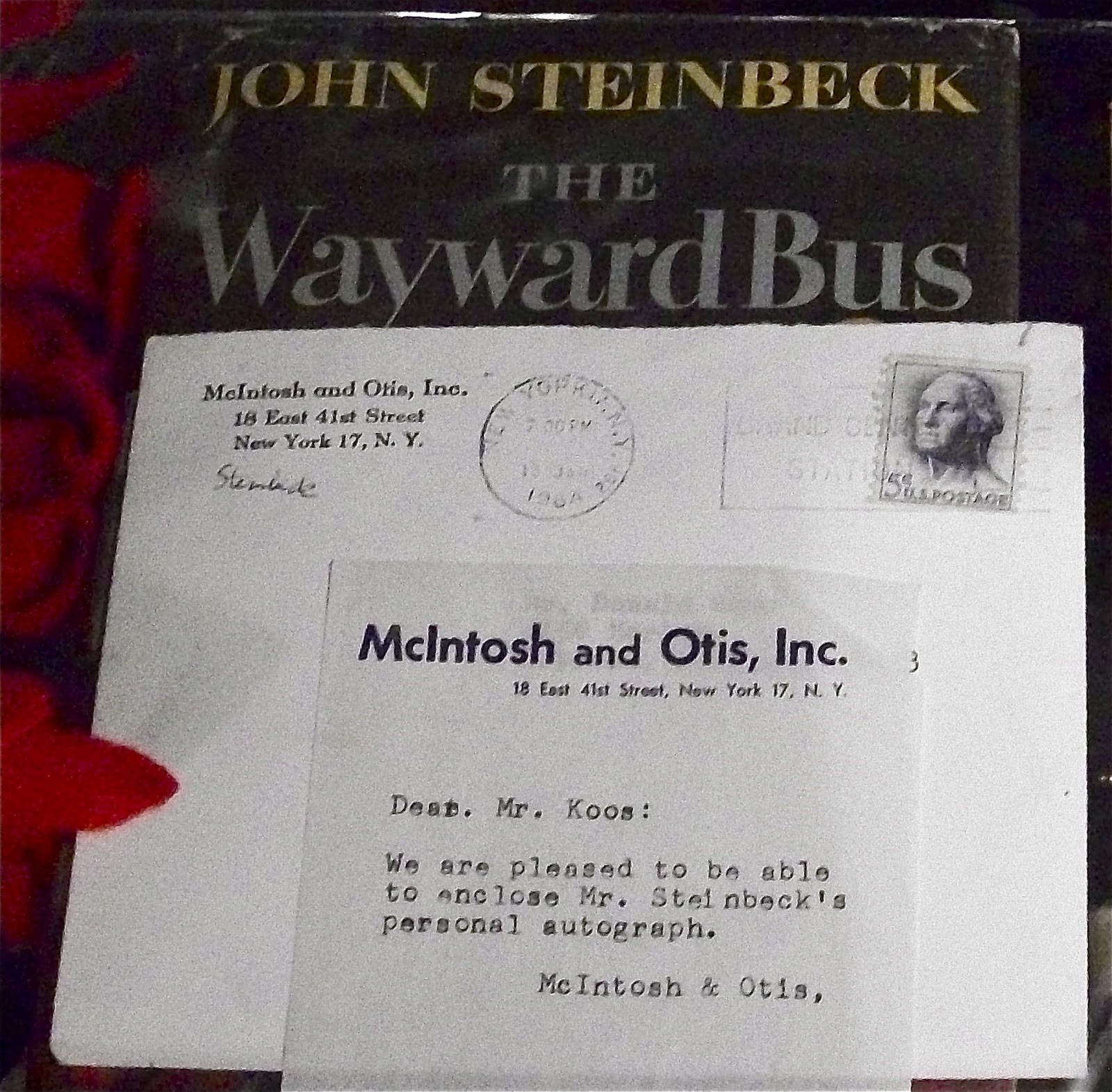
Signed 1st Edition Steinbeck w/Letter
1st Edition
Signed 1st Edition w/Scarce Dustjacket


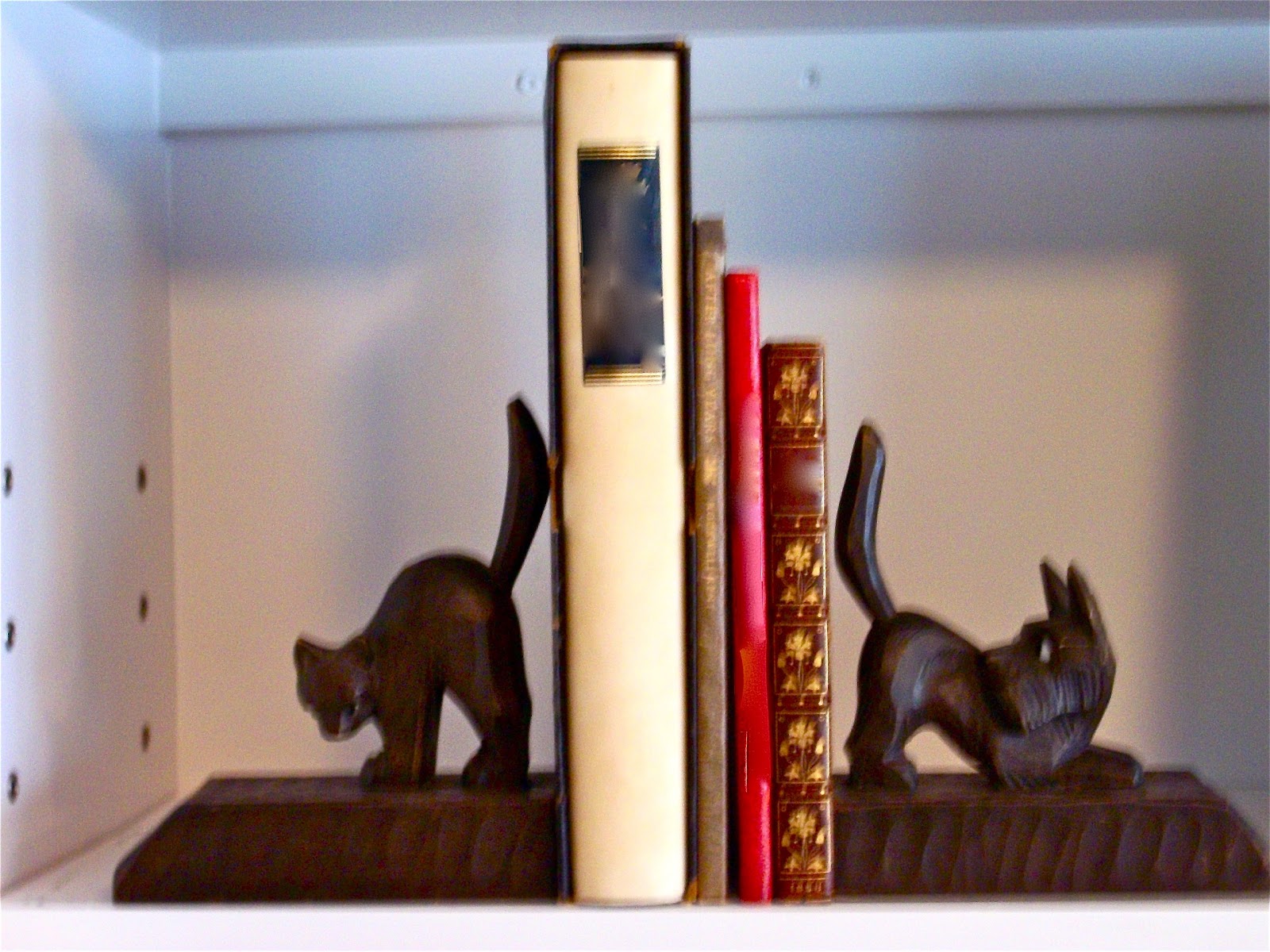
Bookends.
Bookend?

Pen & Pen Holder with it's own Inkwell
Original Drawing by Kate Greenaway


Scarce 1933 Pencil Sketch from the Disney Studios.
 And here's the very best:

Wonderful Inscription from George Bernard Shaw to Douglas Fairbanks Jr.
I have lots of bags and and boxes of books like the one in this photo to sort, catalog, and shelve before reopening day, but before I do that and before I end this post, I want to mention that Pamela Grath of Books in Northport, last week's guest blogger, told me that visits to her blog spiked dramatically after her guest post on this blog.  Of course, we have all of you to thank for that.

So:  Thank you!   And enjoy the new season.