Showing posts with label Film. Show all posts

Thursday, May 24, 2012

FOOTNOTE: What Would You Do?


Families. 

FOOTNOTE, the Israeli film which won the award for best screenplay at the Cannes Film Festival and was nominated for an Oscar as Best Foreign Film at this year’s Academy Awards, is a film which explores the complex and emotionally charged dynamics of families of every kind:  from three generations of a nuclear family to the “families” we create in our work place. 

Anyone who’s ever worked in a university anywhere in the world will recognize the claustrophobic and competitive environment of academic life, where departmental congeniality thinly masks the cut-throat rivalry, jealousy and betrayal in its family of coworkers.

In the 1988 film DOA (Dead On Arrival), the main character, Professor Dexter Cornell (played by Dennis Quaid) has been fatally poisoned, and spends the remaining 3 days of his life trying to find his killer; finally, he learns that he was murdered by a colleague who wanted his tenure!

FOOTNOTE is suspenseful, but not as heavy-handed as DOA — in fact, it’s highly satirical and sometimes, laugh-out-loud funny! — but nevertheless, it precisely captures that politically charged, egotistical world of academia.  Here, the Talmudic Studies department at Hebrew University in Jerusalem is the “family” of professors who carp at each other, who steal ideas from one another, who compete for fame and importance.  Even being mentioned as a “footnote” in a work by a respected scholar is cause for pride and is nurtured like a fetish.

The tightly woven, tension-laden world of the Talmudic scholars is mirrored in the background picture the film gives of modern day Israel, where so much of daily life is subject to interactions with security agents; where simply going into and out of a public building like a library requires patience and restraint — and ideally, a sense of humor!

Apart from those security details, the dilemmas faced in FOOTNOTE are familiar ones; the film is also a keenly observed portrait of both domestic and academic life.  And in this story, the two lives — the two families — are intricately intertwined. 

Father Eliezer Shkolnik and his son, Uriel, are both Talmudic scholars at Hebrew University.  But Eliezer is a self-righteous man, humorless and married to old methods and superseded studies.  He has isolated himself from most of his colleagues and from his family as well; and he’s locked into a bitter disappointment over lack of recognition by anything greater than one small “footnote” in another scholar’s work.

By contrast, his son Uriel is an academic star.  Charismatic and well-liked, he is a part of the world; he plays racket ball, goes to concerts, and wins the kinds of accolades and honors that have eluded his father.

Talk about a generation gap!  Uriel knows how to play the game of life — and the academic game! — while his father does not.

But Uriel feels some guilt about this, and over and over again, he tries to impress and please his father.  Of course, this is an almost impossible task, as his father disparages all those who are welcomed by the establishment that has ignored him.  That Uriel is welcomed into that world angers, disappoints and depresses his father further; he is jealous and anxious to belittle his son’s work. 

Eliezer is finally recognized by being awarded the most important academic prize in Israel.  This totally unexpected prize thrills his son and the rest of his family, and Eliezer is forced to welcome the accolades of those he’d previously scorned.

In a riveting comic but tense scene set in a tiny, crowded and almost suffocating room at the university, Uriel is informed by the members of the awards committee that the award was meant for him and mistakenly given to his father; moreover, it is left for Uriel to tell his father of that decision, to deliver that blow.

These are, indeed, ethical and personal dilemmas. 

What would you do? 

If you were the father, would you accept the award that was bestowed by those whom you do not respect and have criticized for years?  Would you disparage your son and his accomplishments?  Would you be angry that your son, and not you, received that prestigious award?  Or would you embrace your son and feel exalted by his success?

What would you do?

If you were the son, would you give up your prize for your father?  Would you sacrifice the truth for him despite his disloyalty to you?  Or would you claim the prize that was rightfully yours?  Would you be pleased to take your father’s joy from him?  Would you be happy to finally exact retribution for your father’s betrayal and lack of generosity toward you?

What would you do?

In this fine film, you sit on the edge of your seat waiting for the answers to these questions – if, indeed, there are clear-cut answers to be had.

And all the while, you wonder:

What would you do…?

Love, honor, trust, truth, loyalty, grace; and rivalry, anger, frustration, loathing, jealousy, betrayal:  all the stuff of family is portrayed here. Father and son are each tested; the academic and domestic families are tested:  and it is heartbreaking to see....

 
But regardless of what they do to one another, one thing remains a given throughout the film:  these two men are bound to each other.  Forever.
 
Families.
Whatever else we can say of them, families hold within them a link between the generations and a hope for the future.  And of course, nothing does that quite so well as the arrival of a new baby.  
 
Last month I wrote of the birth of  my first grand-baby, Hannah Selma.  Now I happily write of the newest edition to my family:  a beautiful and quite lovely little boy named Leo Nathan.
 
One child had a girl and the other a boy;  but I have both a girl and a boy:  how lucky is that?
 
My family is growing and we are moving into the future together....
 
Leo Nathan -- and I made this blanket, too!


Nana with Leo and Hannah

Saturday, February 4, 2012

Telling Stories Without Using Words


Is it possible to tell a story without using words?  

Yes.  

It’s been done for centuries; and sometimes — even today — it can be the most effective way to tell a particular story well.


Last month the Hollywood Foreign Press Association gave the prestigious Golden Globe award for best film in the comedy/musical category to THE ARTIST, a film without words:  a silent movie.  Never mind that this film was not exactly a comedy; this silent film was appreciated by both the critics and the movie-going public;  they were moved, touched, and involved in a story presented silently on the screen.  

Words and the stories they tell seem inseparable, but neither is necessary for the other.  

Cave paintings, of course, are an early example of story telling without words.  

Those who have been in or have seen photos of the caves in Lascaux remain astonished by the sophistication of the art and “stories” painted on its walls.   

Cave Painting, Lascaux


Paintings, sculptures, music and dance continue to tell us stories: of devotion, of history, of emotion and thought. 

Pantomimes have been performed for centuries.  Even in the most sophisticated of societies, people like the famous beauty, Lady Hamilton, gave performances of what she called “attitudes:” frozen poses and tableaus from myths and other tales.

Lady Hamilton as a Bacchante, by Marie Louise Élisabeth Vigée-Lebrun, 1790–1791

Books, too, can tell stories without words. 
 

I’m not thinking about comic books with their “bubbles” of dialogue; I’m not even talking about more serious “graphic novels” like Art Speigelman’s Pulitzer Prize winning MAUS: A SURVIVOR’S TALE, which uses cartoon art to tell the story of his father’s survival in Nazi Germany; for in these, too, there is dialogue, and there are words to describe the characters’ actions or thoughts.

What comes to my mind is the Belgian artist Frans Masereel’s stunning woodcut novels: graphic, powerful stories and social criticism told without a single word.

 Through the stories he tells in woodcuts,
“Masereel pitilessly castigated man’s ugliness, while praising his beauty.  With rare force, he carved the image of the misery man calls down upon himself, but which he has the power to prevent if he would. With the intensity that characterizes him, he extols humanity, and a society…in which all men are brothers.”
— (Maurice Naessents, Preface to AVERMAETE)
Woodcut from Masereel's THE CITY

So powerful were Masereel’s novels — despite having no words — that the Nazi’s banned his books; and he was even forced to flee from Paris during World War II.
 
THE CITY


Masereel’s work had a lasting influence on many artists — most famously Lynd Ward and contemporary artist Eric Drooker — and his work remains highly esteemed throughout the world.

Lynd Ward from GODS' [sic] MAN


Lynd Ward


Film would seem a natural medium for telling stories without words; it was, after all, first called “motion” pictures!  But though that’s how film began, it's "talking" — speaking words — that's become the way to tell a story on film.   Even so, today's movies have elements of the silent film within them.  Chase scenes, for example, have become a staple of many films, and would be just as effective with silent movie style musical accompaniment as with the screeching tires which accompany them now. 

THE ARTIST has stripped away the words and is a throwback to that earlier way of story-telling on film. 

Anyone who’s ever seen a movie knows the basic story of THE ARTIST:  it's the story of Greta Garbo, moving gracefully from silent movies to “talkies” as opposed to her leading man, John Gilbert, who could not manage it; or it’s SINGING IN THE RAIN — the famous Gene Kelly film which tells the story of that change.  It’s also A STAR IS BORN (1937, 1954,1976) and countless other stories about show business success and failure. 

Yet THE ARTIST manages to make this old story new — and ironically, it makes it new by using an old format: it’s black and white and silent. 

And this film is much more than simply a retelling of those familiar stories.  As actor James Cromwell (who plays the chauffeur in the film) says in his article, ”Why the Quietest Movie in My Career is Making the Most Noise,” the film is
“not just an homage to a bygone era, it [is] a story that would be as contemporary today as it was [then]…[as it depicts] the idea of the world moving on without you, and the knowledge…that we are replaceable.”
Who among us cannot identify with that?  (Certainly, booksellers can!)  And what better way to make that universal fact seem timeless than to illustrate it using the storytelling methods of a “bygone” era? 

All of the other films released in time for the awards season are ones with words, often lots of them!  But the words do not necessarily move the plot along, or foreshadow what’s to come, or reveal a person’s character.
A DANGEROUS METHOD purports to show the birth of modern psychoanalysis through the interactions between Freud, Jung and their patient (the future — and first female — psychoanalyst), Sabina Speilrein.  This is a wordy movie in which the words serve to obscure what is actually occurring:  Jung is using word-therapy to rationalize an affair with this young woman; and to try to establish himself and his methods as superior to Freud’s.

Words, words, words:  yet everything important we learn about Jung in this film is learned from his actions:  the way he enjoys beating his female protégé; the way he “talks” his reluctant mentor, Freud, into joining him on a working tour of America, yet thinks nothing of taking his privileged, clueless self to a first-class berth and leaving Freud — speechless! — in tourist.   And finally, we get to know Jung’s driven personality best through the words written on the screen at the film’s end:  he had a nervous breakdown and emerged from that breakdown as one of the most influential of psychiatrists.  

In a better film, these written words would not have been necessary; perhaps the film needed more action.   Certainly, the spoken words didn't avoid the need for writing that explanatory note on the screen….
TINKER TAILOR SOLDIER SPY is a wordy film about British spies that is based on the John Le Carre novel of the same name.  This is no James Bond thriller:  there is little action; there are no car chases; and few murders.  Instead, it’s primarily about words, paper, and power.  As must be true of real espionage, the words are often meant to obscure, are meant to cover up what’s actually occurring.  (This slow-paced, wordy film can be so obscure that some reviewers joked that it should be seen early in the day, when the mind is still “fresh…!”) 

It’s an interesting film; yet perhaps the most exciting scene — the one that has you sitting on the edge of your seat, the one which makes you understand that these wordy old men do dangerous work and can themselves be dangerous — is a scene with almost no words. 

Throughout the film, one is silently shown stacks of papers that are housed in intelligence headquarters:  papers read, filed, put on dumbwaiters, stored.  In this suspenseful scene, we watch a spy try to steal a file.  There he is in a building filled with other spies, trying to remove classified papers from the building. Without getting caught.

He needs to sign in and out; he needs to relinquish his briefcase; he needs to make appropriate small-talk; he needs to keep his cool….  This scene is riveting, and gives one a fuller picture of the world of spies and spying:  a fuller story than the one they’d been conveying with words.
CARNAGE is a Roman Polanski film based on the play, GOD OF CARNAGE.  Like the play, this is a wordy story of two couples — strangers — meeting to discuss what’s to be done about a violent playground altercation between their 9-year old sons. 

Theater is a wordy medium.  Even when film was silent, theater was not.  Nevertheless, in this wordy play which has four adults say unbelievably horrible things to one another, the scene in the play which most roused the audience was a strictly visual one:  a guest  vomits all over a table laden with precious “cocktail table” books.  The audience roars. 

The film is almost like a stage reading, but even the shortening of the title shows an attempt here to be less wordy and more visual.  As with the play, that very visual vomit scene gets the most audience attention.  But the thing that brings the point of the story home — and is not in the play — is a wordless scene at the end of the film. 

For almost two hours, we listen to four adults saying the most outrageous and uncivilized things; we see all kinds of fighting — couple against couple, husbands against wives, women against men, men against women — in their attempt to deal with their children’s bad behavior.  We watch as relationships change, perhaps permanently.  Then, in this final scene, while their parents are still arguing, we're shown [from a silent and respectful distance] the two boys playing together again:  as though nothing bad had ever happened between them.  The boys are more civilized, more rational -- more adult! -- than their parents. 

Here, we see silence telling a story, and telling it very well.  Again, James Cromwell makes the point quite clearly: 
“Ultimately, acting on any film…is telling the truth while pretending it’s fiction.  It’s often very difficult to do with words...because [words] so rarely mean what we use them to say.”
I can end here — but I won’t; because although "a picture is worth a thousand words," often enough, it’s not:  you need words to know the whole story.  

I hope you enjoy this “story” that's been all over Facebook; the words are very important.

Saturday, December 24, 2011

What Readers Can Learn from Woody Allen

I’ve always liked Woody Allen.  Not so much the slapstick stuff – I usually can’t get into slapstick – but the wit, the insights, the ease with which he demolishes long held beliefs which few dare question:  he’s willing to say that the emperor is naked....

And he is funny.  Very funny.  Even some of the slapstick films have flashes of this wit, of comedy that’s not physical, but verbal.  In SLEEPER, one of his more slapstick films, a man goes into the hospital for an easy surgery; something goes wrong, and his body is “frozen” until he can be cured.  When he awakens in the year 2173, he’s told to reflect on the miracle of science he's been privileged to experience.  But he is not appeased:  to him, a miracle of science would have been to leave the hospital after a few hours and not have gotten a parking ticket!

And no one who has listened to the discussion of the dietary value of eggs – sometimes good for you, sometimes not – can help but be both amused and satisfied to learn that 200 years from now, it becomes a “well known” fact that things like wheat germ and honey are bad for you, while “tobacco is one of the healthiest things there is.”  And deep fat.  And hot fudge….

Satisfying, too, is the way he creates wish-fulfilling experiences we can relate to, as in this memorable scene from ANNIE HALL featuring Marshal McLuen:


I also love  -- and envy! -- the way he can “define” complicated concepts in one short sentence.  In STARDUST MEMORIES, he tells us that he took a course in existential philosophy.  On his final exam he was asked 10 questions he couldn’t answer; so he left them all blank – and got a 100% !

In the same way, he can define a decade – the sixties – in a sentence, tracing a person’s trajectory from hippy-dom to a career in advertising or finance.  And in ANNIE HALL, we see him describe an upper west side New Yorker in one spot-on sentence:


With ANNIE HALL, Allen began his more “serious” period of film making:  that is, while many of these films are still very funny, there is much less physical comedy, and there’s an increasing effort to deal with more serious subjects:  the state of the universe; the difficulty of interpersonal relationships, of preparing for the future, of knowing what one wants; the struggle to understand the purpose of one’s life; and the moral imperatives that must guide one’s actions.

Nowhere is that better stated than in the film MANHATTAN, and in particular, in the scene in which Allen talks to his friend while standing next to a schoolroom skeleton. 


Woody Allen in a scene from MANHATTAN

Allen confronts a friend who betrayed him, and his friend tells him not to “turn this into one of your big moral issues…. I’m not a saint, OK?”
Allen:  “But you’re too easy on yourself!  Don’t you see that?  That’s your problem….you rationalize everything; you’re not honest with yourself.  You cheat a little [on your wife], you play around with the truth a little with me:  next thing you know you’re in front of a Senate Committee and you’re naming names, you’re informing on your friends.”

Friend:  “You’re so self-righteous!  We’re just people!  We’re just human beings.  You think you’re God!”

Allen:  “I gotta model myself after someone!  …what are future generations going to say about us?  It’s very important to have some kind of personal integrity.  I want to make sure that when I’m [dead] I’ll be well thought of.”
You watch a scene like this, you hear these words, and you can’t help but think that Woody Allen, the creator of them, has admirable moral standards; that he is someone worth emulating.

And then:  he has an affair with the daughter of Mia Farrow (his “significant other”).  He has an affair with a young girl whom he helped raise.... 

What?!?  Really?!?

PBS TV’s AMERICAN MASTERS series recently devoted two nights to Woody Allen.  Here, he’s shown as the creative genius that he is; as the highly prolific and imaginative filmmaker; and one of the very few filmmakers to have complete control of the content and production of his films;

Here, he is shown to be more egocentric than collaborative – he won’t discuss film roles with his film's actors because he doesn’t like talking to them! – and one who seems to realize a great deal of what he wants in his films during the editing process;

Here, Allen tells us that his film collaboration with Mia Farrow went well “until things suddenly started to fall apart in our relationship…." (Talk about understatement!)

Here, in the very few minutes devoted to the subject in a 4 and 1/2 hour documentary, we are told that Woody Allen’s work did not suffer as a result of the sensational trial and custody battle that ensued:  that [like any narcissist], "Woody was able to compartmentalize” the different parts of his life.  And to rationalize: rationalize and ignore any unpleasantness.  "What was the scandal?" he asks in one interview.

This is so contrary to the dialogue he wrote for MANHATTAN (and for so many of his other films) that it's no wonder that Allen says in this documentary that he didn’t like MANHATTAN and was sorry that it had been released…!

But if Allen understands neither his misconduct nor the "scandal" it caused, his biological son, Rowan Farrow, clearly does. This is what Rowan said of his estrangement from his father:
"He's my father married to my sister. That makes me his son and his brother-in-law. That is such a moral transgression.  
I cannot see him. I cannot have a relationship with my father and be morally consistent... I lived with all these adopted children, so they are my family. To say Soon-Yi was not my sister is an insult to all adopted children.”
So:  What can readers learn from Woody Allen?  

Well, readers can learn that the writer is NOT the same as the tale he tells.  Or that he is ALL parts of the tale: the good, the bad; the moral and the immoral.  The reader can learn that, perhaps, studying the lives of writers and artists does not help in understanding the work; that the work must be examined on its own merits..

Woody Allen tried to tell us this himself in his film, SWEET AND LOWDOWN, which Netflix describes as a “fictional biopic about a jazz guitarist…that separates an obnoxious man from his heavenly musical ability.” 

You simply can’t interpret the art by using what you know of the life of the artist.

But on the other hand:

All those many, many films that feature betrayal and deception, like HANNAH AND HER SISTERS, in which Hannah’s sister has an affair with Hannah’s husband;

All those many, many films like CRIMES AND MISDEMEANORS, MANHATTAN, WHATEVER WORKS, which pair old men with young – sometimes very young – women;

And all those many, many films that display a dilution and finally an abandonment of the moral standards he’d originally expressed in dialogue like the one in MANHATTAN. 

In 1989's CRIMES AND MISDEMEANORS, the “hero” has his young mistress killed; it’s a crime he unable to bring himself to do by himself, and it is a crime he gets away with.  But the immorality of his actions and the fact that he is not punished for them changes him:  his belief in God is shaken; his understanding of the meaning of life is lost; and he is distraught, worried, distant, and filled with guilt and despair.

By the time we get to 2005's MATCH POINT, the “hero” is not only perfectly capable of killing his mistress by himself, but thinks nothing of killing her innocent next door neighbor so that the killings will seem the result of random robberies.  And after a short bout of sleeplessness and worry that he'll be caught, he becomes perfectly happy to have gotten away with it; perfectly happy to enjoy the good life he gained through murder; perfectly happy to move ahead and not give his heinous actions a second thought.

Why hadn’t we noticed this tendency of Allen’s?  Perhaps because it did not neatly fit our image of him; perhaps because this is not funny stuff….and we expect funniness from this "master" of film.  And the documentarians excuse him by never giving any of this more than a passing glance – even expressing admiration of him for being able to “compartmentalize” so well….

It’s hard to know how and if a writer’s life informs his work; it’s hard to know whether or not we do a disservice to the work by delving into the life. 

So:  Do we really know anything much about William Shakespeare?  And does it matter?

What do you think?

Sunday, October 2, 2011

Guest Post: Bookshop Movies

This is a “guest” post by my friend and fellow bookstore owner, Pamela Grath.  Her store is in Michigan, but her blog, Books in Northport, is linked from my Books Blog under “Blogs I Follow.”
 
Back in 1996, Pamela came to our bibliofind.com site, and I had the pleasure of helping her join and learn the ropes.  She and I have never met, but obviously, we enjoy many of the same things – including our April Fools' Day birthdays! – and we have remained in contact over the years.

You will see when you go to her blog that Pamela is an enthusiast – about books, about animals, about nature, and about her part of the world – and her photographs are often so stunning that you want to get on a plane and go there immediately! For now, though, we’ll have to content ourselves with her blog.

But the best description of Pamela is the one she uses to describe herself on her blog:
Blogger, bookseller, philosopher, photographer, writer. Negligent but devoted gardener.  Good cook when inspired. No kind of housekeeper at all.
Here, without further ado, is Pamela’s post.  Enjoy!

Bookshop Movies
Harold groaned when she told him to read everything again. He thought he’d be bored out of his mind, going back and reading the same books he’d already finished. He was stunned to find that the second time through they were different books. He noticed entirely different points and arguments. Sentences he had highlighted seemed utterly pointless now, whereas sentences he had earlier ignored seemed crucial. The marginalia he had written to himself now seemed embarrassingly simpleminded. Either he or the books had changed. 
– David Brooks, The Social Animal: The Hidden Sources of Love, Character and Achievement
I maintain that the same is true of movies, that you can never watch the "same" movie twice, an assertion that shocked the Philosophy and Film instructor whose teaching assistant I was one semester. In our house, David and I are re-watchers as well as re-readers. The other evening we re-watched a wonderfully witty Hugh Grant and Julia Roberts movie, “Notting Hill.” The number of great almost-throwaway lines in the script had us hooting aloud. 


The bookstore [someone's big chance: the real bookstore is now for sale] doesn’t play a huge role in “Notting Hill,” but naturally it’s part of the attraction of the movie for a bookseller, and that got me to thinking about other films with bookstore settings. The one that leaps to mind first is the obvious, the popular “You’ve Got Mail.” With Tom Hanks and Meg Ryan, who can resist? And the movie has a happy ending, too, with the out-of-business bookstore owner turning children’s book author--probably not the fate of many bookstore proprietors who have gone out of business. Please note that “The Shop Around the Corner,” starring Jimmy Stewart, the film that inspired “You’ve Got Mail,” was set in a leather goods store, not a bookstore. Whole different kettle of fish, from a bookseller’s perspective. How's the market for leather goods these days?

The movie version of “84 Charing Cross,” definitely a bookshop story, was nowhere near as good as the book, but I’m sure it’s hard to make a movie out of years of mail correspondence, with no face-to-face encounters and no action, nothing but the requesting and receiving of books mailed across the Atlantic. Perhaps it ought not to have been attempted. 


The Amy Irving character in “Crossing Delancy” works in a bookstore, and, as the organizer of author events, she enjoys the touch of literary glamour on the fringes of her job. The focus of the movie, however, is her search for Mr. Right; as in “Notting Hill,” the bookstore in “Crossing Delancy” is not the main setting of the movie. On the other hand, it’s more than just a brief scene.... Scene? Seen? (Synapses fire, and the mind leaps.) Have you seen “The Answer Man” with Jeff Daniels? Now there’s a film that covers all the bases, from a writer’s life and secrets and his agent’s agonies through the vicissitudes of publishing to the struggles of retail bookselling. I found it riveting and hilarious. 


Poking around, I have come up with a couple of movies I never heard of before featuring bookstore themes. Anyone know anything about “The Bookstore” or “Heaven’s Bookstore”? Both are foreign films, the latter Japanese, neither listed on Netflix. I’ve added “The Love Letter” and “Read You Like a Book” to my queue. Will I be disappointed? 


Here’s what’s really on my mind: What I'm dying to see are film versions of Christopher Morley’s two classic novels about the bookselling life, Parnassus on Wheels and The Haunted Bookshop. “Could they be updated to a modern setting?” David asked. No, no, a thousand times no! They are period pieces! They are, as I said, classics, iconic works for American booksellers, especially those of us who sell used books and grew up on the Morley dreams. Roger Mifflin must drive the countryside from farm to farm in his horse-drawn gypsy-style wagon in the first story, and the second absolutely must be set in the World War I era. Anything else would be heresy. Please, someone make these movies--but for God’s sake don’t screw them up! 


The Philco-Goodyear Television Playhouse, which ran from 1948 to 1955, apparently presented "Parnassus on Wheels" in 1951. I wonder if it was any good. Why has no one since produced film versions of these stories of the eccentric bookseller from Brooklyn? As printed books become objects of nostalgia, surely the time is ripe, and America is ready, for a movie that would dwell lovingly on this important part of our cultural heritage? 


Postscript: If you don't know Christopher Morley, introduce him to yourself with this short essay on the thrill of visiting bookshops with an explorer's attitude of discovery, and you'll see why we booksellers with open shops continue to adore this writer as the world whirls by our doors.

Sunday, September 25, 2011

Food Writing

I’m not a great cook, but I nevertheless love to read books that include a fair amount of food-writing. By that, I don’t mean cook books – I can’t “taste” food by reading a recipe the way some of my “foodie” friends can. And I also don’t mean books like Gwyneth Paltrow’s, which are essentially recipe books with some background about why the author is interested in food, family and healthy life-choices….

The food books I love are novels, memoirs, travel books, etc., in which food helps drive the plot; or in which food is the vehicle which illuminates the characters, or is shown to “form” their personalities, or describes their relationships with others; or which illustrate how food and cooking can serve to comfort or empower.

This is a large and varied genre.

WOMEN WHO EAT is a collection of essays by women in which they describe their various relationships with food. Some are professional cooks, but most are writers who tell of their feelings and memories of food. It’s a celebration of food and of women who enjoy food without shame or apology.


There are lovely essays about bonding with grandparents while working in the kitchen together; there are reflections about the pleasure of making a meal, because it is one of the few activities in which there are no “loose ends,” as a meal “has a beginning, middle, and end.” Simple and clear.

Because I'd had similar experiences, I especially enjoyed the essay by Pooja Makhijan, whose mother would put exotic “aloo tikis” into her lunch box, so unlike the “American” food her classmates had in theirs – and theirs were the kind of lunches she'd always longed for!

With the same good intentions, my mother would often pack my brown paper bag with a [healthy] whole tomato to bite into like an apple (juice running down my chin and neck) and a sandwich on rich rye bread. And oh, how I, too, longed for a sandwich on real “American” white bread!

Most of the essays in this book were entertaining, though none felt entirely "new."  And I hope you'll excuse me if I say that they're a bit like appetizers before the main course....

In Ruth Reichl’s memoir, TENDER AT THE BONE, the former restaurant critic and editor of the now defunct GOURMET magazine remembers a childhood that prepared her for a future in the food world. Reichl describes in sometimes hilarious detail, her early and strange connection with food.


Her "manic-depressive" mother loved to entertain, and depending on her mood, or on the latest “bargain” of ready-for-the-garbage food, or whatever decaying carcass she found in her larder, she often served food that was spoiled or moldy. Before the age of 10, Reichl understood that “food could be dangerous” and saw it as her “mission…to keep Mom from killing anybody who came to dinner.” She sometimes stood in front of guests to prevent them from getting to the buffet; and bluntly told her own friends, “Don’t eat that,” as they unsuspectingly plunged their spoons into dishes like bananas in green sour cream.

Her role as “guardian to the guests” made her aware of food in a way that might not have occurred otherwise. She began “sorting people by their tastes” and finding that she could learn a lot about people from the foods they chose and the places in which they liked to eat. And she continued to observe and learn about food as she made her way from New York to a French boarding school in Montreal and a commune in Berkeley; as she came under the wings of people like Alice Waters and James Beard.

Liberally sprinkled with recipes, this adventure in food has a happy ending, as Reichl got to live her passion of cooking and eating and teaching people about food.

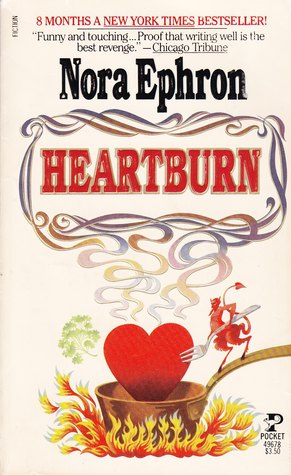
Nora Ephron’s HEARTBURN is a slyly fictionalized account of her divorce from journalist Carl Bernstein. The novel’s heroine, Rachel, is a food writer, and Ephron uses food and recipes as the conceit with which to describe Rachel’s relationship and marriage, from its beginning to its end.


Seven months pregnant at the time that she discovers that her husband is having an affair, Rachel reviews the trajectory of their marriage:

When first in love, [she] prepares labor-intensive and time-consuming “crisp potatoes;” when they settle into a married life busy with a child and home improvements, it’s the complacency and self-assuredness of “peanut butter and jelly on white bread.” (Yum!) With the knowledge of her husband’s affair, it’s “heartburn” and a punishing refusal to give him her wonderful vinaigrette recipe. Then it’s self-pity and the comfort of mashed potatoes…. Finally, she accepts that she can do without him, and expresses that acceptance by throwing a pie in his face – and by her willingness to give him that vinaigrette recipe after all: in essence, she is saying, “You can have it, and I’m out of here!”

Forget the Meryl Streep and Jack Nicholson film of the same name; this is a delicious, insightful, and wickedly funny book. And the great recipes are an added bonus.

More and more common in the food-writing genre are the books that tell of people moving to a “foreign” country and navigating their way through that new landscape. And food is a major player in these journeys.

In Marlena De Blasi’s A THOUSAND DAYS IN VENICE, American restauranteur and cookbook writer De Blasi tells of her love-at-first-sight romance with a Venetian man she sees across a crowded room – really! – and of her move to Venice to be with him. And for all its beauty, it’s an inhospitable Venice she comes to, steeped as it is in old traditions which have no room for newcomers.


But De Blasi haunts the local food markets at 5:00 AM each morning, and with her knowledge and love of food, she seduces the locals and becomes “one of them.” Then, she repeats this feat in her sequel, A THOUSAND DAYS IN TUSCANY, where she eats at the small local restaurant to which everyone in the neighborhood – including she – brings food for communal dining. Soon, she is one of them there, too.

Passionate about food, De Blasi describes the local produce and the markets and the centuries’ old food traditions with eloquence and ease. You read these books with mouth-watering pleasure – and a longing to become an “insider” in Italy, too!

Finally, there’s the food-writing in travel books that have no plots to speak of, but which describe food’s connection to the land, the landscape, the city, the town, the community. These books give you a sense of the rhythm of life there; and you are like a voyeur, looking through the windows of the folks who are living the dream.

Peter Mayle’s A YEAR IN PROVENCE and Frances Mayes’ UNDER THE TUSCAN SUN are two such books. In these, we watch the British Mayle and the American Mayes (with their very similar names!) as they renovate fabulous houses with seemingly unlimited funds. Here, too, we see them prepare the local foods of the season, and discover the bounty of the land.


These are books you can dip into, reading a passage here and there, now and then. And sometimes, you’re rewarded with an unforgettable description of the connection between food and nature and the life cycle, as in this excerpt from UNDER THE TUSCAN SUN:
“The fig flower is inside the fruit. To pull one open is to look into a complex, primitive, infinitely sophisticated life cycle…. Fig pollination takes place through an interaction with a particular kind of wasp about 1/8 of an inch long. The female bores into the developing flower inside the fig. Once in, she delves with her…needle nose, into the female flower’s ovary, depositing her own eggs. If she can’t reach the ovary, she still fertilizes the fig flower with the pollen she collected from her travels. Either way, one half of this symbiotic system is served – the wasp larvae develop if she has left her eggs, or the pollinated fig flower produces seed. If reincarnation is true, let me not come back as a fig wasp. If the female can’t find a suitable nest for her eggs, she usually dies of exhaustion inside the fig. If she can, the wasps hatch inside the fig and all the males are born without wings. Their sole, brief function is sex. They get up and fertilize the females, then help them tunnel out of the fruit. Then they die. Is this appetizing, to know that however luscious figs taste, each one is actually a little graveyard of wingless male wasps? Or maybe the sensuality of the fruit comes from some flavor they dissolve into after short, sweet lives.”
It’s fig season: enjoy them!

Tuesday, September 6, 2011

“Live in HD” versus “Live at the Met”


I'd never been an opera-lover, but I love the Metropolitan Opera's Live in HD broadcasts, and it has increasingly made more of an opera fan of me.

The operas are broadcast at the same time as they are being performed, so they’re seen “live” all over the world:  what a Massachusetts audience sees at 1:00 PM, an Arizona audience sees at 11:00 AM, a California audience at 10:00 AM – and so on, in all parts of the country and all over the globe.  It’s exciting to know that others are watching the same event with you, at the very same moment, no matter the time zone.

And in the comfort of your seat and the murmur of the people around you, you can almost feel as though you're an actual part of the same audience that you watch trickle into the Met; it can feel a bit like they’re joining you in your theater; and that the huge chandelier is hanging over your head, as well:  the very expression of a theater-goers “willing suspension of disbelief!”

But as the hosts on screen keep reminding us, “There’s nothing like actually being to a performance at the Met” – and, of course, that’s true. The acoustics are better at the Met, and therefore, the sound; certainly, the glorious music and those magnificent voices deserve that. 

And the excitement of entering that huge and opulent theater cannot be matched by that of even the loveliest local movie theater; or even by watching on the giant screen at Times Square – though I’m sure there’s quite a feeling of excitement there, too!  

Grand Opera deserves a grand space, and the Met certainly is that!

But in that grand, huge space, it’s often very difficult – if not impossible! – to see the facial expressions of the performers; to see the cut of the jewels; the opulent velvets and silks and lace; to see how hard the performers work – to see them sweat!  In the Live in HD broadcasts, however, you do get to see all of that.  Occasionally, the camera focuses on individual members of the chorus and of the musicians in the pit: these performers are plucked out of their seemingly homogenous crowd, and are suddenly unique members of the cast in a way that cannot be experienced in the Met.

I like this – and I don’t. 

At the Met, you can see the entire stage at all times, so in a very real sense, you become the “editor” of the action, as you decide where you will look, who you will concentrate on.  In the broadcasts, the choices are made for you, and sometimes those choices leave me dissatisfied.  

Nevertheless, I prefer the HD broadcasts because of the “extras” that the HD audience enjoys and which the opera house audience does not get to see.

While the members of the audience at the Met go for a stretch or sit restlessly in their seats, we at the movie theaters get to go behind the scenes.  We enjoy interviews with performers, directors, conductors, set and lighting designers – even animal trainers! – and I find those enormously interesting – especially when it’s a conductor’s or a performer’s first time at the Met. Their excitement is contagious! Often enough, the comments they make during these interviews – their interpretations of the roles, their enthusiasm – serve to intensify one’s pleasure in what is to come. And you find yourself rooting for them!

But the “extra” I like best is that during intermissions, we get to watch the crew change the sets behind that closed curtain:  and that is a simply wondrous, remarkable experience.  Entirely new worlds are created in 20 minutes; and you're on pins and needles, never believing that they'll manage it! I think it's worth the cost of admission just to see that!


Of course, opera's vary in the complexity of the sets, so some are more interesting than others. 

SIMON BOCCANEGRA is a case in point. This opera personifies what opera is all about:  grand passions, timeless themes, extraordinarily sumptuous sets and costumes – and it’s a real tearjerker, too!  The sets for this production were staggeringly lavish, complex and diverse. 

There were over 130 workmen (yes, all men!) changing the sets.  One set was "rolled" onto the stage – with performers already in their places! – while others were built before our eyes. 

With hammers and nails, fabric and boards, a concrete-and-stone street with dark alleys and brooding gray-stone buildings was turned into a lusciously landscaped walled garden with a honey-colored "cottage" and gazebo; the garden and its walls were then turned into a palace throne room, complete with elaborately inlaid marble floors, heavily carved wood-paneled walls, and ornately painted frescoed ceilings...! 

You watch, and you just can't believe your eyes!  Some men hammer “grass” cloth onto the “stone” floor, while others make sure that there are no bumps, no snags, nothing that might make a performer trip and fall.  These are experts in their field, and despite their speed, they pay attention to the smallest details.

And all the while, on the lower right-hand corner of the screen, you watch the 20 minutes count down by seconds:  at 7 minutes to go, you just don't believe it's possible, and you sit in anxious suspense.  6, 5, 4….  At 3 minutes to go, back stage is still bustling with activity.  And at 1 minute, they’re gone! 

Poof!  The music begins, the curtains open….

This is itself a perfectly choreographed “performance.”  It is theater.  It is deserving of standing ovations.  And it is thrilling to see!


I think that the Metropolitan Opera is best for opera lovers; and that the Live in HD broadcasts are perfect for theater lovers.  Take your pick – or pick them both!  
This season’s tickets are on sale now.