Tuesday, February 14, 2012

A Valentine Bouquet

This post is unlike any of the others I’ve done, but with only 18 posts in all, I suppose that I haven’t yet established a pattern....   

I’ve written about books as objects; about auctions; about theater and opera and film; about public and private libraries; about aspects of literary analysis and different ways of telling stories; and I’ve written about my store.  I’ve even had “guest posts” and plan more of them. 

Besides, this is my blog, so I can post anything I want!  

Today is Valentine’s Day and the airwaves are filled with the films and the music of love; and everywhere, flowers are being brought and sent. 

“Classical” music stations seem to be spending much of the day playing romantic waltzes and tangos; and primarily classical music that has been used as themes in romantic films.  Actually, this post is a perfect follow-up to my last one about telling stories without [necessarily] using words.  Here, music is the main story-teller, and it inspires the action. 

So as a Valentine from me to you – and through the wonders of the Internet – here is a “bouquet” of music and video to make this a romantic day, wherever you are and whatever you’re doing. 

Enjoy.

Ravel's "Bolero" in the movie, TEN starring Dudley Moore and Julie Andrews:

Rachmaninov:
     THE SEVEN-YEAR ITCH starring Marilyn Monroe: 


  SOMEWHERE IN TIME starring Christopher Reeve and Jane Seymour:  

Tangos:
    from an old Rudolph Valentino film:
 

     from Robert Duvall’s film, ASSASINATION TANGO: 


     from the film SHALL WE DANCE starring Jennifer Lopez and Richard Gere: 

              and several breathtaking clips from TANGO ARGENTINA:


Waltzes:
         from THE ARTHUR MURRAY DANCE PARTY, a television  show from the 1950’s:
the New York City Ballet performing THE MERRY WIDOW, choreographed by George Balanchine and featuring Peter Martins:
  
           Disney's spin on Tchaikovsky's "Sleeping Beauty Waltz:"


And one of my favorite pieces, a “bouquet” of sorts: Natalie Dessay and Delphine Haidan singing the “Flower Duet” from the opera LAKME:

And finally, The Kiss: 

The Kiss
Happy Valentine’s Day!

Saturday, February 4, 2012

Telling Stories Without Using Words


Is it possible to tell a story without using words?  

Yes.  

It’s been done for centuries; and sometimes — even today — it can be the most effective way to tell a particular story well.


Last month the Hollywood Foreign Press Association gave the prestigious Golden Globe award for best film in the comedy/musical category to THE ARTIST, a film without words:  a silent movie.  Never mind that this film was not exactly a comedy; this silent film was appreciated by both the critics and the movie-going public;  they were moved, touched, and involved in a story presented silently on the screen.  

Words and the stories they tell seem inseparable, but neither is necessary for the other.  

Cave paintings, of course, are an early example of story telling without words.  

Those who have been in or have seen photos of the caves in Lascaux remain astonished by the sophistication of the art and “stories” painted on its walls.   

Cave Painting, Lascaux


Paintings, sculptures, music and dance continue to tell us stories: of devotion, of history, of emotion and thought. 

Pantomimes have been performed for centuries.  Even in the most sophisticated of societies, people like the famous beauty, Lady Hamilton, gave performances of what she called “attitudes:” frozen poses and tableaus from myths and other tales.

Lady Hamilton as a Bacchante, by Marie Louise Élisabeth Vigée-Lebrun, 1790–1791

Books, too, can tell stories without words. 
 

I’m not thinking about comic books with their “bubbles” of dialogue; I’m not even talking about more serious “graphic novels” like Art Speigelman’s Pulitzer Prize winning MAUS: A SURVIVOR’S TALE, which uses cartoon art to tell the story of his father’s survival in Nazi Germany; for in these, too, there is dialogue, and there are words to describe the characters’ actions or thoughts.

What comes to my mind is the Belgian artist Frans Masereel’s stunning woodcut novels: graphic, powerful stories and social criticism told without a single word.

 Through the stories he tells in woodcuts,
“Masereel pitilessly castigated man’s ugliness, while praising his beauty.  With rare force, he carved the image of the misery man calls down upon himself, but which he has the power to prevent if he would. With the intensity that characterizes him, he extols humanity, and a society…in which all men are brothers.”
— (Maurice Naessents, Preface to AVERMAETE)
Woodcut from Masereel's THE CITY

So powerful were Masereel’s novels — despite having no words — that the Nazi’s banned his books; and he was even forced to flee from Paris during World War II.
 
THE CITY


Masereel’s work had a lasting influence on many artists — most famously Lynd Ward and contemporary artist Eric Drooker — and his work remains highly esteemed throughout the world.

Lynd Ward from GODS' [sic] MAN


Lynd Ward


Film would seem a natural medium for telling stories without words; it was, after all, first called “motion” pictures!  But though that’s how film began, it's "talking" — speaking words — that's become the way to tell a story on film.   Even so, today's movies have elements of the silent film within them.  Chase scenes, for example, have become a staple of many films, and would be just as effective with silent movie style musical accompaniment as with the screeching tires which accompany them now. 

THE ARTIST has stripped away the words and is a throwback to that earlier way of story-telling on film. 

Anyone who’s ever seen a movie knows the basic story of THE ARTIST:  it's the story of Greta Garbo, moving gracefully from silent movies to “talkies” as opposed to her leading man, John Gilbert, who could not manage it; or it’s SINGING IN THE RAIN — the famous Gene Kelly film which tells the story of that change.  It’s also A STAR IS BORN (1937, 1954,1976) and countless other stories about show business success and failure. 

Yet THE ARTIST manages to make this old story new — and ironically, it makes it new by using an old format: it’s black and white and silent. 

And this film is much more than simply a retelling of those familiar stories.  As actor James Cromwell (who plays the chauffeur in the film) says in his article, ”Why the Quietest Movie in My Career is Making the Most Noise,” the film is
“not just an homage to a bygone era, it [is] a story that would be as contemporary today as it was [then]…[as it depicts] the idea of the world moving on without you, and the knowledge…that we are replaceable.”
Who among us cannot identify with that?  (Certainly, booksellers can!)  And what better way to make that universal fact seem timeless than to illustrate it using the storytelling methods of a “bygone” era? 

All of the other films released in time for the awards season are ones with words, often lots of them!  But the words do not necessarily move the plot along, or foreshadow what’s to come, or reveal a person’s character.
A DANGEROUS METHOD purports to show the birth of modern psychoanalysis through the interactions between Freud, Jung and their patient (the future — and first female — psychoanalyst), Sabina Speilrein.  This is a wordy movie in which the words serve to obscure what is actually occurring:  Jung is using word-therapy to rationalize an affair with this young woman; and to try to establish himself and his methods as superior to Freud’s.

Words, words, words:  yet everything important we learn about Jung in this film is learned from his actions:  the way he enjoys beating his female protégé; the way he “talks” his reluctant mentor, Freud, into joining him on a working tour of America, yet thinks nothing of taking his privileged, clueless self to a first-class berth and leaving Freud — speechless! — in tourist.   And finally, we get to know Jung’s driven personality best through the words written on the screen at the film’s end:  he had a nervous breakdown and emerged from that breakdown as one of the most influential of psychiatrists.  

In a better film, these written words would not have been necessary; perhaps the film needed more action.   Certainly, the spoken words didn't avoid the need for writing that explanatory note on the screen….
TINKER TAILOR SOLDIER SPY is a wordy film about British spies that is based on the John Le Carre novel of the same name.  This is no James Bond thriller:  there is little action; there are no car chases; and few murders.  Instead, it’s primarily about words, paper, and power.  As must be true of real espionage, the words are often meant to obscure, are meant to cover up what’s actually occurring.  (This slow-paced, wordy film can be so obscure that some reviewers joked that it should be seen early in the day, when the mind is still “fresh…!”) 

It’s an interesting film; yet perhaps the most exciting scene — the one that has you sitting on the edge of your seat, the one which makes you understand that these wordy old men do dangerous work and can themselves be dangerous — is a scene with almost no words. 

Throughout the film, one is silently shown stacks of papers that are housed in intelligence headquarters:  papers read, filed, put on dumbwaiters, stored.  In this suspenseful scene, we watch a spy try to steal a file.  There he is in a building filled with other spies, trying to remove classified papers from the building. Without getting caught.

He needs to sign in and out; he needs to relinquish his briefcase; he needs to make appropriate small-talk; he needs to keep his cool….  This scene is riveting, and gives one a fuller picture of the world of spies and spying:  a fuller story than the one they’d been conveying with words.
CARNAGE is a Roman Polanski film based on the play, GOD OF CARNAGE.  Like the play, this is a wordy story of two couples — strangers — meeting to discuss what’s to be done about a violent playground altercation between their 9-year old sons. 

Theater is a wordy medium.  Even when film was silent, theater was not.  Nevertheless, in this wordy play which has four adults say unbelievably horrible things to one another, the scene in the play which most roused the audience was a strictly visual one:  a guest  vomits all over a table laden with precious “cocktail table” books.  The audience roars. 

The film is almost like a stage reading, but even the shortening of the title shows an attempt here to be less wordy and more visual.  As with the play, that very visual vomit scene gets the most audience attention.  But the thing that brings the point of the story home — and is not in the play — is a wordless scene at the end of the film. 

For almost two hours, we listen to four adults saying the most outrageous and uncivilized things; we see all kinds of fighting — couple against couple, husbands against wives, women against men, men against women — in their attempt to deal with their children’s bad behavior.  We watch as relationships change, perhaps permanently.  Then, in this final scene, while their parents are still arguing, we're shown [from a silent and respectful distance] the two boys playing together again:  as though nothing bad had ever happened between them.  The boys are more civilized, more rational -- more adult! -- than their parents. 

Here, we see silence telling a story, and telling it very well.  Again, James Cromwell makes the point quite clearly: 
“Ultimately, acting on any film…is telling the truth while pretending it’s fiction.  It’s often very difficult to do with words...because [words] so rarely mean what we use them to say.”
I can end here — but I won’t; because although "a picture is worth a thousand words," often enough, it’s not:  you need words to know the whole story.  

I hope you enjoy this “story” that's been all over Facebook; the words are very important.

Thursday, January 19, 2012

Comments Posted on My Blog

Many of the comments posted on my blog are quite interesting and insightful; and they leave much room for thought.  I know that many blog readers don’t read the comments, so I’ll share some of them here.

My last post, The Year (of My Blog) in Review, prompted some sympathetic comments on behalf of the author, Nina Sankovitch, whose book,  TOLSTOY AND THE PURPLE CHAIR, I’d panned.  The book was a record of her year reading a book a day as a means of  “healing” herself after the death of her sister. 

About this post, two people I respect felt that I was, perhaps, a bit hard on the author and her book.

Karen wrote,
“Ouch, go gettem, Helen!  I admire a mind that is clear on her opinions….”
And Pamela wrote, 
“In defense of Nina Sankovitch (I have not read her book), I want to note that grief is a very strange country to inhabit and that she was probably doing the best she could to go on after losing her sister….  Maybe it shouldn’t have been a book—clearly, it wasn’t a book for you at that time—but I have read essays and letters and such by other people who took up books in times of grief, and one of the things they have in common is that almost every written word the grieving reader encounters, however trivial, seems to take on a different coloration and become a personal message from the Universe.  And really, that’s quite wonderful, isn’t it?  Anything written out of that kind of grief is almost like a letter from another plane.”
I suppose I was feeling a little defensive when I responded, as follows:
“My initial reflex was to feel chastened by suggestions that I have been hard and unkind in my analysis of Nina Sankovitch’s book.  (I faced the same discomfort when I had to grade my students’ papers!)

I certainly don’t want to be hard on people; but I do want to be honest.

It’s interesting to note that when I wrote some pretty awful things about Tolstoy in my post on WAR AND PEACE, not only did no one complain about it, but I was cheered by many.  Of course, it becomes more sensitive when it is a living author who is being discussed; nevertheless, I think it’s important to remain honest in one’s assessment of a work, no matter the circumstances. 

I’m certainly sympathetic to the author’s grief:  but it does not excuse bad writing.  If one can grant Sankovitch the right to use reading as a way to ease her grief, and for finding in each book a lesson to be learned and a reflection of her own experiences, we can’t grant her the right to make statements which mean nothing—‘The book is perfect, a genuine communication of the heart.’—nor to use a false premise for her ‘project.’

If reading can, indeed, ease her suffering, why must it be a book a day?  Why can’t books or authors be reread?  Some books that could have helped her might take longer to read; some favorite authors might elicit new insights in a rereading of them.  Choosing an inch-wide spine has nothing at all to do with reading as a healing mechanism; instead, it seems more like an arbitrary decision—or one which she thought would help her get a book published!

In this day when it is more and more difficult for good writers to get their work published, I think we need to be extra diligent in doing what we can to discourage publishers from publishing books of poor quality—or from publishing them because they have some kind of “gimmick” to recommend them.
 It’s not called literary ‘criticism’ for nothing!”
As for Tolstoy:  although most agreed with my assessment of WAR AND PEACE, several suggested that I give Tolstoy another chance by reading ANNA KARENINA.  So, I plan to do that—but not quite yet!

I made some errors in a few of my posts, and those were caught by readers. 

I’d said that one could see Jude Law’s HAMLET on Netflix, but I was mistaken.  The best you can do is see scenes from it on YouTube; but there are lots of scenes there, so you’d practically be seeing the entire play!


In my post, Some Thoughts About Books as Objects, I’d said that I had friends who had Elizabeth Barrett Browning’s set of Homer.  Well, I was wrong on 2 counts:  The set was of Euripides, not Homer; and my friends no longer own it:  they’ve sold it!  If you want to see those amazing books, you'll find them at the Armstrong Browning Library at Baylor University in Waco, Texas.

The post on What Makes a Good Personal Library prompted someone to say that “Most of the voluminous private libraries I’ve seen are for show only.” 

In my reply to that, I noted that this is certainly true of some private libraries.  After all, there are people who buy books by the yard or beautifully bound books of blank pages and the like (see The Year (of My Blog) in Review for more on that).

But I also commented that such people still chose books to look at rather than a collection of Rolex watches—which I’ve also seen in some houses I've gone to!  And I noted that
“many private libraries can be ‘personal’ ones as well—which is what I titled my post—in that books in them need not be valuable, but only important to [the owner] in some way:  important enough to drag heavy boxes of books from place to place, as I (and others) have done over and over again.”
The post on Public Libraries had Marash Girl tell us the sad news about her local libraries:
"Here's to the little local library, the library that is disappearing, the library that opened our hearts to books, the library that we walked to on our way to [school], the library that is not economically viable in the greater scheme of things.  After Newton, Massachusetts closed all of its village libraries, it built the most expensive high school in the U.S.  Go figure.  If kids don't learn to love books/libraries/knowledge from their earliest days, what good is the most expensive high school in the U.S.?"
I agreed with her:
"One doesn't need an expensive school. (Didn't Socrates do all his teaching in a grove?)  All one needs are good teachers and good libraries.  Now, even universities  build libraries at the outskirts of the school, or in one awful case, underground!  You can go to school in these places and never even know that there is a library!  In days of old, the library was the center of schools and communities."
In What Readers Can Learn from Woody Allen, I used Woody Allen to ask the question of whether or not it’s appropriate to focus on the life of the artist when analyzing the artist’s work.  The answer to this question is not so clear, as is indicated by Freckles’ comment:
“My first reaction is this:  actors, writers, musicians, sports figures, etc. are lauded for their talents and then burdened with the public’s need to like them.  Why?  Why do I need to like Woody Allen and approve of his life choices in order to enjoy his films?
Because he is famous, I am exposed to ‘inside information’ that would otherwise be none of my business.  I may not like the information, but the facts themselves do not detract from his talent—just from my ability to enjoy his talent.  For me, Allen’s ‘scandal’ does muddy the waters of what used to be clear enjoyment.   It sneaks up on me and puts a damper on things.  I have, however, made a conscious decision to continue seeing his films and to try to enjoy them.
Mel Gibson, not so much….
I’m glad Shakespeare didn’t have to contend with tabloids and documentaries; he would have never made it.”
And finally, in my last post I had photos of sculptures made out of books and asked the question, “are they ‘art’ or are they the destruction of books by other means?”

Is it a book?  Is it art?  Is it craft?
One commenter suggested that these were not art, but “at best, a form of recycling…”  But commenter Karen made an intriguing point when she wrote:
“I share your uneasiness about the implications [of sculptures made from books], and THAT is probably what makes them ‘Art.’  The fact that they were left on the doorsteps of libraries and bookstores anonymously adds to their mystique.  They are skillfully executed, to be sure, but skill alone does not make art.  It’s the imagination, the edginess it causes, the attention it brings to a world that is morphing so fast that one can hardly hang on to what they love before it is swept aside by the winds of change.  It’s a commentary on the changing nature of choice.”
Let’s hope that in all this change and with all these choices, books will maintain their important place in our lives and in society.

Have you a comment on any of the comments?

Monday, January 2, 2012

The Year (of My Blog) in Review

You can hardly pick-up a newspaper or magazine; can hardly turn on the radio or TV, without getting a rundown of the year in review.  Here's mine:  The 2011 Year of the "Books Books Books" Blog in Review – and a few additions to begin the year 2012.

There are only 15 posts on my blog.  I began it in August with the post, “What I’m Planning, more or less” which told a bit about me and my reading history, and what I planned for my Blog. 

What it didn’t say was that I began the blog in a fit of pique over a book I’d been reading called TOLSTOY AND THE PURPLE CHAIR.  It’s a “project” book, and project books annoy me—whether it’s a recipe-a-day or a book-a-day, such projects seem artificial to me, not a natural part of one’s day, of one’s life.

This book’s project was to read a book a day for a year.  And the project had strict rules:  no re-reading books that had been read before; no author could be read more than once; only books “with a width of one inch” (!) would be chosen; mystery books were for Sundays; books must be finished by midnight; and every book read must be written about.

Nina Sankovitch’s book was well reviewed in the New York Times, and it is that which prompted me to read it.   I’d hoped it would provide me with a list of books worth reading; and that I would glean new insights into books and writing.

But much of this book illustrates the author's struggle to justify her project, to give it a plausible purpose; but unfortunately, she does not succeed.    

Sankovitch’s sister died after a short and devastating illness.  As a result, Sanksovitch was 
“caught in a bramble patch of sorrow and fear.  My reading…was pulling me out of the shadows and into the light."
 She tells us that
“Now that [my sister] had died [and my family was devastated], I was doing what I could to recover…for everyone in my family.  I was reading.”
"In reading books, I was finding my sister again.”
And--perhaps most unbelievably!--she identifies her reading project and herself with 
“an impoverished Cuban man," a character in one of the books she’s reading, because they both have “hope for the future.  He has faith in Castro’s revolution; I have faith in the power of books.”
What?  (Or as my children would say, “Puh-lease!”)

Which leads to another problem with this book:  Sankovitch tries to shoehorn every one of the books she reads into a lesson that will ease the pain of her sister’s death.  Sometimes this works, but more often, it doesn’t.

So many books read much too quickly!  Ultimately, we learn little about them other than a bit of the  plot, and how the characters and the lessons they learn feel similar to Sankovitch's own experience;

So many books read so quickly that we, the readers, get little beyond a series of platitudes repeated over and over again in different words, no matter what she happens to be reading, as in:
“We cannot control events around us, but we are responsible for our reactions to those events.”
“The meaning of my life is ultimately defined by how I respond to the joys and the sorrows…”
“[The character] comes to understand then that his own sanity depends upon his accepting what he cannot change.”
OK: we get it!

And although Sankovitch states that “the purpose of great literature is to reveal what is hidden and to illuminate what is in darkness,”(?) when she does spend some time describing and analyzing her one-day–to-read-it books, she uses words and phrases that tell us nothing: 
“This book is perfect, a genuine communication from the heart.”
“[We are] connected to the rest of humanity...by the size of our hearts."
“The world shifts, and lives change.
“I would find...the always within never.”
Here, once again I must ask—“What?”

I know how difficult it is to write, so I hate to say it, but I think that the New York Times was wrong:  this is not a good book.  Sankovitch is probably a good reader and a good writer, but I think that here—perhaps because she turned reading into a “project” and read the books too quickly, chose some of them too poorly—she couldn’t do the books (or herself) justice.

So my blog was to be an antidote to this approach:  I would read books over and over again, I would write about books and film and theater; and as a slow reader, I wouldn’t predict how frequently I would post.

And that’s how it began:  Analyses of WAR AND PEACE, books of food writing; a review of Jude Law as HAMLET; a reflection on the difference between Live in HD and Live at the Met, etc.

And then, the Blog took on a life of its own.  I'd posted my musings about book auctions and books as objects, and these generated a huge—and surprising—interest from readers in many parts of the world.  So, the discussion continued:  of private libraries and public libraries; a bit about literary analysis which used the films of Woody Allen for its examples; thoughts about the rising fear that books—and bookstores—would soon be a thing of the past…  And here we are.

As these thoughts continued to reverberate, readers sent me suggestions for posts, and even sent me things to post.  Here are some of them:

Danny wrote,  “Here's a magnificent blog I thought you'd enjoy:  <NeglectedBooks.com>
I do enjoy it.  And it’s the perfect companion to the book I’ve been reading and which I highly recommend:  SECOND READING. NOTABLE AND NEGLECTED BOOKS REVISITED, by Jonathan Yardley.

The posts on Personal Libraries prompted Johanna to alert me to an astonishing and rather depressing article in the New York Times called “Selling a Book by Its Cover” which talks about “book solutions” and expresses surprise that there are people who want “more than pretty bindings: [they] wanted the option of being able to read [their] books.”  (Imagine that!)

The article tells of “books wrapped in silver paper to match the silver hardware in the room….

You think that’s bad?  It gets worse:  
“For the spa in Phillipe Stark’s Icon Brickell, the icy glass condo tower in Miami, 1,500 books [were wrapped] in blank white paper, without titles, to provide a ‘textural accent’ to the space.”  They bought “mass-market hardcovers that flood the used book outlets — titles by John Grisham and Danielle Steel, or biographies of Michael Jackson— because they are cheap, clean and a nice, generous size.”
And worse:  
“A TV news program wanted linen-wrapped books chopped in half to fit the shallow, faux-shelves of a political interview program.”
Moreover, the writer of this NY Times article thinks "book lovers" should be grateful that physical books are being “kept alive” by the “library artist” who is more “than a mere book dealer.”  (“Mere book dealer?”  That would be me…)

A not-to-be-missed slide show is included in this article, and the last 2 items in it are “books” that have been used as a medium for the creation of “art.” 

Which brings me to Andre, who wrote to me about this very subject:  “I thought these very beautiful and mysterious sculptures [made from books] which have been turning up anonymously in honor of libraries and books around the world was worth a look....”

I took a look, and here are photos of some of those sculptures:


Staying on theme by having a Tyrannosaurus Rex bursting from Doyle's LOST WORLDS

I don’t know what to make of this or quite how I feel about it.  Some of these are, indeed, beautiful:  but are they “art” or are they the destruction of books by other means?  Do they “honor” libraries or make a mockery of them?

I'm curious to know what you think about this.

So that was my Blog in 2011: behind us now. 

Now it's the year 2012, during which you have 365 (make that 363) days to: 

Read. 

Make art using any medium you like. 

Write to me as much as you want; I will always reply. 

            And most importantly:

Visit your local booksellers:  we are not and never have been “mere!”
- - - - - - - - - - -
Postscript: 

Apologies to those of you who receive blog posts via email for receiving an unfinished post.  I simply pressed the wrong button -- publish instead of preview -- and off it went.  (Could this have been the result of too much celebrating?)

The internet is an unforgiving medium; but I hope that you will be forgiving...

Thank you, and have a very Happy New Year.

Saturday, December 24, 2011

What Readers Can Learn from Woody Allen

I’ve always liked Woody Allen.  Not so much the slapstick stuff – I usually can’t get into slapstick – but the wit, the insights, the ease with which he demolishes long held beliefs which few dare question:  he’s willing to say that the emperor is naked....

And he is funny.  Very funny.  Even some of the slapstick films have flashes of this wit, of comedy that’s not physical, but verbal.  In SLEEPER, one of his more slapstick films, a man goes into the hospital for an easy surgery; something goes wrong, and his body is “frozen” until he can be cured.  When he awakens in the year 2173, he’s told to reflect on the miracle of science he's been privileged to experience.  But he is not appeased:  to him, a miracle of science would have been to leave the hospital after a few hours and not have gotten a parking ticket!

And no one who has listened to the discussion of the dietary value of eggs – sometimes good for you, sometimes not – can help but be both amused and satisfied to learn that 200 years from now, it becomes a “well known” fact that things like wheat germ and honey are bad for you, while “tobacco is one of the healthiest things there is.”  And deep fat.  And hot fudge….

Satisfying, too, is the way he creates wish-fulfilling experiences we can relate to, as in this memorable scene from ANNIE HALL featuring Marshal McLuen:


I also love  -- and envy! -- the way he can “define” complicated concepts in one short sentence.  In STARDUST MEMORIES, he tells us that he took a course in existential philosophy.  On his final exam he was asked 10 questions he couldn’t answer; so he left them all blank – and got a 100% !

In the same way, he can define a decade – the sixties – in a sentence, tracing a person’s trajectory from hippy-dom to a career in advertising or finance.  And in ANNIE HALL, we see him describe an upper west side New Yorker in one spot-on sentence:


With ANNIE HALL, Allen began his more “serious” period of film making:  that is, while many of these films are still very funny, there is much less physical comedy, and there’s an increasing effort to deal with more serious subjects:  the state of the universe; the difficulty of interpersonal relationships, of preparing for the future, of knowing what one wants; the struggle to understand the purpose of one’s life; and the moral imperatives that must guide one’s actions.

Nowhere is that better stated than in the film MANHATTAN, and in particular, in the scene in which Allen talks to his friend while standing next to a schoolroom skeleton. 


Woody Allen in a scene from MANHATTAN

Allen confronts a friend who betrayed him, and his friend tells him not to “turn this into one of your big moral issues…. I’m not a saint, OK?”
Allen:  “But you’re too easy on yourself!  Don’t you see that?  That’s your problem….you rationalize everything; you’re not honest with yourself.  You cheat a little [on your wife], you play around with the truth a little with me:  next thing you know you’re in front of a Senate Committee and you’re naming names, you’re informing on your friends.”

Friend:  “You’re so self-righteous!  We’re just people!  We’re just human beings.  You think you’re God!”

Allen:  “I gotta model myself after someone!  …what are future generations going to say about us?  It’s very important to have some kind of personal integrity.  I want to make sure that when I’m [dead] I’ll be well thought of.”
You watch a scene like this, you hear these words, and you can’t help but think that Woody Allen, the creator of them, has admirable moral standards; that he is someone worth emulating.

And then:  he has an affair with the daughter of Mia Farrow (his “significant other”).  He has an affair with a young girl whom he helped raise.... 

What?!?  Really?!?

PBS TV’s AMERICAN MASTERS series recently devoted two nights to Woody Allen.  Here, he’s shown as the creative genius that he is; as the highly prolific and imaginative filmmaker; and one of the very few filmmakers to have complete control of the content and production of his films;

Here, he is shown to be more egocentric than collaborative – he won’t discuss film roles with his film's actors because he doesn’t like talking to them! – and one who seems to realize a great deal of what he wants in his films during the editing process;

Here, Allen tells us that his film collaboration with Mia Farrow went well “until things suddenly started to fall apart in our relationship…." (Talk about understatement!)

Here, in the very few minutes devoted to the subject in a 4 and 1/2 hour documentary, we are told that Woody Allen’s work did not suffer as a result of the sensational trial and custody battle that ensued:  that [like any narcissist], "Woody was able to compartmentalize” the different parts of his life.  And to rationalize: rationalize and ignore any unpleasantness.  "What was the scandal?" he asks in one interview.

This is so contrary to the dialogue he wrote for MANHATTAN (and for so many of his other films) that it's no wonder that Allen says in this documentary that he didn’t like MANHATTAN and was sorry that it had been released…!

But if Allen understands neither his misconduct nor the "scandal" it caused, his biological son, Rowan Farrow, clearly does. This is what Rowan said of his estrangement from his father:
"He's my father married to my sister. That makes me his son and his brother-in-law. That is such a moral transgression.  
I cannot see him. I cannot have a relationship with my father and be morally consistent... I lived with all these adopted children, so they are my family. To say Soon-Yi was not my sister is an insult to all adopted children.”
So:  What can readers learn from Woody Allen?  

Well, readers can learn that the writer is NOT the same as the tale he tells.  Or that he is ALL parts of the tale: the good, the bad; the moral and the immoral.  The reader can learn that, perhaps, studying the lives of writers and artists does not help in understanding the work; that the work must be examined on its own merits..

Woody Allen tried to tell us this himself in his film, SWEET AND LOWDOWN, which Netflix describes as a “fictional biopic about a jazz guitarist…that separates an obnoxious man from his heavenly musical ability.” 

You simply can’t interpret the art by using what you know of the life of the artist.

But on the other hand:

All those many, many films that feature betrayal and deception, like HANNAH AND HER SISTERS, in which Hannah’s sister has an affair with Hannah’s husband;

All those many, many films like CRIMES AND MISDEMEANORS, MANHATTAN, WHATEVER WORKS, which pair old men with young – sometimes very young – women;

And all those many, many films that display a dilution and finally an abandonment of the moral standards he’d originally expressed in dialogue like the one in MANHATTAN. 

In 1989's CRIMES AND MISDEMEANORS, the “hero” has his young mistress killed; it’s a crime he unable to bring himself to do by himself, and it is a crime he gets away with.  But the immorality of his actions and the fact that he is not punished for them changes him:  his belief in God is shaken; his understanding of the meaning of life is lost; and he is distraught, worried, distant, and filled with guilt and despair.

By the time we get to 2005's MATCH POINT, the “hero” is not only perfectly capable of killing his mistress by himself, but thinks nothing of killing her innocent next door neighbor so that the killings will seem the result of random robberies.  And after a short bout of sleeplessness and worry that he'll be caught, he becomes perfectly happy to have gotten away with it; perfectly happy to enjoy the good life he gained through murder; perfectly happy to move ahead and not give his heinous actions a second thought.

Why hadn’t we noticed this tendency of Allen’s?  Perhaps because it did not neatly fit our image of him; perhaps because this is not funny stuff….and we expect funniness from this "master" of film.  And the documentarians excuse him by never giving any of this more than a passing glance – even expressing admiration of him for being able to “compartmentalize” so well….

It’s hard to know how and if a writer’s life informs his work; it’s hard to know whether or not we do a disservice to the work by delving into the life. 

So:  Do we really know anything much about William Shakespeare?  And does it matter?

What do you think?

Tuesday, December 6, 2011

Public Libraries

There seems to be so much interest in terms of books as “objects” that one can practically have a blog devoted to that subject alone!  I have received heaps of email on the subject.  (Strictly speaking, email doesn’t really come in “heaps” – but it really felt like it!)  It’s quite an interesting subject, to be sure, and I will revisit it from time to time.

My blog post, What Makes a Good Personal Library, prompted a wide range of opinions, from “how fabulous to have a personal library,” to “how pretentious,” to “save trees by reading eBooks,” and everything you can imagine in between.

But there’s something about walking into a room full of books – whether it’s a library or a bookstore or a friend’s living room – that feels wonderful:  the scent; the muffled silence (as many sounds are absorbed into the walls of books); the colors and patterns of the book-filled shelves; the enticing anticipation created by all those beckoning spines….

While some libraries fill you with a sense of ease and comfort when you walk into them, others fill you with wonder – and awe. 

Public libraries are a luxury that all of us can enjoy.  In New England, every tiny village was built around its own library.  One might think that this creates an unnecessary redundancy, but local libraries can give you a very homey, welcoming feeling; it’s a place where you see familiar faces and know exactly where to look for the books you want.  It can be so welcoming a place that you are drawn to visit it more often than you might a larger and less intimate one.

But there are other libraries that offer a completely different experience.  When you step inside one of those, you often find that you need to pause for a moment, look around, survey the scene, and drink in the room’s  “landscape” before you venture further inside.

I recently stumbled upon a website which featured “The 35 Most Amazing Libraries in the World,” and the libraries are – amazing!  Each of the 35 libraries is photographed and described so as to explain why they were chosen.  It’s an informative list, and although I’ll be posting some photos here, I urge you to visit the site and look at them all.

I have been fortunate enough to have been in some of these libraries – Trinity College Library in Dublin, the Bodleian in Oxford, the British Museum Reading Room in London, the Vatican Library, the New York Public Library, Yale’s Beinecke Library, the Boston Public Library, the Morgan Library in New York, the Peabody Library in Baltimore, Phillips Exeter Academy Library in New Hampshire, the Library of Congress – and I can say that every time, my experiences exceeded my expectations. 

No matter how august the setting, how precious the books, how steeped with history the building, you can always find a friendly-faced librarian who is eager to show you around, to share the library’s treasures with you.  (And what treasures there are!)  Book lovers seem to love book lovers, wherever they appear. 

In a few of these libraries, I was given special, behind-the-scenes tours, and while that was, indeed, exciting, it’s the reading rooms – the rooms everyone has access to! – that gave me the most pleasure.  You can view and even touch unimaginable treasures in these repositories of civilization and history; you can do research; you can even read!  (I have to admit, though, that just looking and wandering around is what I most enjoy.)

When in such libraries, I feel much as my children did when they looked at our [temporarily owned] copies of the 2nd and 4th Shakespeare Folios; I feel the magic, the wonder, the awe.  I tread softly and touch slowly, carefully.  And I feel lucky.

Here are photos of some of the libraries featured on that website which I found particularly interesting.

The Stockholm Public Library was built in 1928, and I’m surprised at how modern it looks.  I love the way the visitor is surrounded by books, and that the books on the balconies are also open to view and are accessed by an open staircase.  Such balconies remind me of one of my “dream” libraries:  the one belonging to Henry Higgins in MY FAIR LADY!

Stockholm Public Library

Jose Vaconcelos Library


How’s the Jose Vaconcelos Library in Mexico City for modern?  While this  architecture can be considered impressive, I prefer the books to take center stage rather than the architecture.  Here the books don't beckon to me adequately, but perhaps it feels different when you're actually inside the building.


 The Library of Alexandria, Egypt, is another modern space.  If you’re wondering where the books are, at the moment there are only 500,000 books in a space that is meant to hold over 8,000,000!  
Library of Alexandria


It is hoped that this library will recreate the library that was known as the “greatest library in antiquity” before it was destroyed.


Phillips Exeter Library


Famed architect Louis Kahn designed the modern Phillips Exeter Academy Library.  The building won many architectural awards, and it was even used as a  commemorative postage stamp!  While this photograph emphasizes the architecture and looks rather cold, this is one of the libraries I visited, so I can tell you that it doesn’t feel that way when you’re inside.  There are many intimate spaces in which  small groups can gather, the collection is notable, and the books are very accessible.  


When I worked as a reference librarian and book purchaser for the  Howard County Library in Maryland, we got all of our inter-library loans from the George Peabody Library in Baltimore.  Howard County is midway between Baltimore and Washington D.C., and Columbia, a modern, “planned” city – the first of its kind in the U.S. – was built there.  With all the competitive people working in that cosmopolitan government and business corridor, it's easy to forget that Maryland is a Southern state and fought for the Confederacy during 
The Peabody Library
the Civil War; but when you step into the Peabody, you're quickly reminded:  those ornate iron railings on the balconies almost shout "New Orleans and the South!  It's a wonderful library.


The Trinity College Library Long Room has become something of a tourist attraction.  Those roped-off bays are a bit off-putting, but if you really want to do research, you can arrange an appointment and work there.  I love libraries that have such open “bays.”

The Long Room at Trinity College Library
The Morgan Library

The Morgan Library is also a museum, and the book shelves are gated so that you can’t really get at them but can only look at them as a kind of permanent exhibit. But the rooms are magnificent and the exhibits are always worth seeing.  Here, too, you can ask for permission to actually use the books.


The Chateau de Chantilly Library: what can I possibly say other than "WOW!"

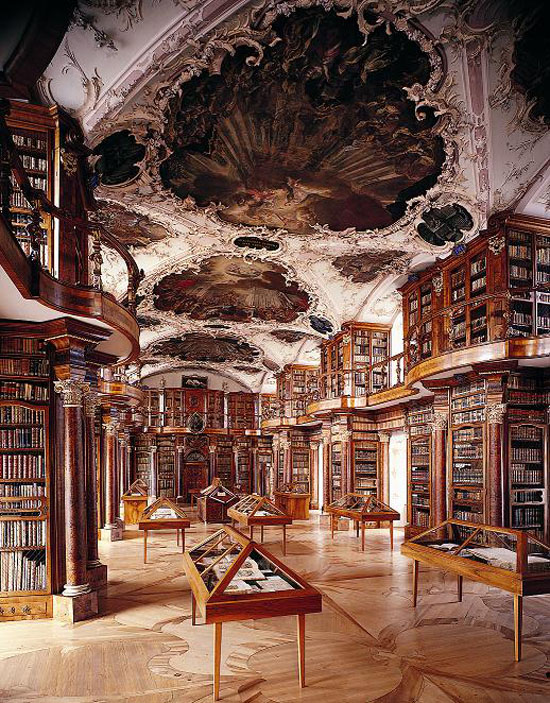
Abbey Library of Saint Gall


I’ve never been to the Abbey Library of Saint Gall, but one 
of my favorite books is the exquisite 3 volume monograph of 
THE PLAN OF ST GALL published by the University of 
California Press in1979.  The original plan was drawn on vellum between the years 820 and 830 CE - and survived!  Astonishing that the public is welcome to use this library!

The New York Public Library

Sometimes I feel as though I spent a third of my life at the New York Public Library.  I lived and went to school in New York, and this was my library of choice.  It was a great and inspiring place to study - and a wonderful place to meet people, too!

The Boston Public Library was the first public library in the U.S. and is my current library of choice.  You can see from this photo what I mean when I say that some libraries are hushed, dreamy, and magical….

Boston Public Library
Beinecke Library
In addition to being beautiful and having an amazing collection of rare books and manuscripts, Yale’s Beinecke Library is also extremely high-tech. That central air-tight column of glass which houses and preserves the most rare of the books is a modern marvel; it’s even been featured in novels and film as the place where the good-guy gets locked into and must find his way out before he stops breathing – or where the bad guy finally stops breathing!


Reading Room at the British Museum
The relatively new Reading Room at the British Museum does not have the charm of its predecessor, but it has an impressive collection of books; and I love that such a wonderful museum has a library as its centerpiece.


For me, Oxford University’s Bodleian Library is the very definition of what a library should be.  One of the oldest libraries in Europe, it has everything:  impressive history, important works, and great beauty – inside and out.  It consists of several buildings, with the Radcliffe Camera Science Library the most beautiful among them.  I love this building so much that I actually bought a paper construction kit of it and made myself a small replica that now sits on my desk.  I love to look at it.


Radcliffe Camera of the Bodleian Library

The Library of Congress really does have everything:  it is the largest library in the world, “as measured by shelf space and number of volumes.”  And just think:  it belongs to us!  

Library of Congress

Wouldn’t it be great to travel to all the great public libraries in the world?  And in each of those libraries, you’d probably find a fellow book-lover eager to show you around….

But in the meantime: visit, support and enjoy your local libraries!