Tuesday, November 29, 2011

Guest Post: Reading "Rules"


Everywhere one looks, it seems that bookstores are closing or becoming cafés, or that they are selling things other than books:  book things, but not books themselves.    There is a constant lament from booksellers, publishers, writers and the media about the death of the book, the end of reading.  These lamenters tell us we prefer video and film and interactive games and books on tape to actually reading silently to ourselves.

Most recently, this sentiment was expressed on the cover of the NEW YORKER – one of several they’ve published in recent years heralding the end of book selling, book reading, and book buying as we know it.  (Not funny!)


But if you were to spend a little time “surfing” the web, you would be forgiven for thinking that the naysayers are not paying sufficient attention.  There are thousands of books sites on the web.  Practically anyone who reads puts up a blog about their book likes and dislikes; there are book review sites in which books are reviewed by committee; there are book discussion sites; book club sites; book seller sites; book author sites; “modern” book sites; “classic” book sites; science-fiction book sites; mystery book sites; chick-lit book sites; book-a-day sites; library sites; and even book sites which review other book sites!

It is daunting.

I said in my very first post, What I'm Planning More or Less..., that I am a very slow reader, and that I couldn’t possibly read all that there is to read, let alone all that I want to read!  Even dipping into these book sites takes more time than I can comfortably manage!

But help has come my way….

Since 1985, Judy Pollock – a close friend of mine for more years than I care to mention! – has been president of Language at Work,  a communication skills training company.  Judy has been a reading teacher, a professional actor, and a public speaker; and she has designed many courses that help others communicate more easily and confidently.  Her clients range from private individuals to businesses and government agencies.

But Judy has had a “hands-off” policy when it came to her friends, and it is only since I began this blog and have been whining to her about my slow reading that she has finally come to my rescue.  While I can’t say that I am now a speed-reader, I can say that I read much faster than I did only a few months ago.

I am posting here one of the things she sent me that I found helpful; I hope it helps those other slow readers out there, as well as those who want to supplement their reading skills.  If you have questions about her post or other communication concerns, you can email Judy directly; or check out her web blog to see what else she has to offer.

Happy reading!
- - - - - - - - - - - - - - - - - - - 
Reading “Rules”

Reading is wonderful, but not for everyone. What I frequently hear is, “How I can get through all the things there are to read?  I’m such a slow reader.”  Or worse: “I don’t have time to read fiction.” 

Slow readers can learn to read faster, and all readers can improve their skills. Contrary to what we’d like to think, efficient reading requires some work, and most of the strategies are appropriate for non-fiction.  But, if you can step up your non-fiction speed, you’ll have more time for luxuriating in your fiction!

Here are some things to try:
1.  Silence the voice that says you have to finish reading anything you start.  I give books 100 pages to convince me.  If you’re slogging through books you don’t like, no wonder you don’t have time to read anything else.  And how can you be excited about starting a new book if it means a mandatory sentence of 300+ pages! 
2.  Don’t think you have to read every article in the magazine.   Look for articles that you might want to read.  Tear them out; throw the rest of the magazine away.

3.  Don’t read every article in the same way.  Some will yield their treasures to you with a quick skim.

4.  Identify your reading places: watching TV, in bed, by the phone, in the kitchen.  Here is where you should stash potential reading material. 
Match the material to the place: some things you will skim quickly; some you want to read carefully; some you just need to review; some you want to curl up and read for enjoyment; some you have to work at.  

Now you have a stack of quickies by the phone to whip through while you’re on hold.  You have magazines for previewing in your TV watching chair. Your current book is by your bed, and the latest gobbledy-gook about your health insurance is on your desk where you will presumably be clear-headed and sitting up straight.
5. Preview everything you can.  Look at the title, subheadings, captions, side-bars, table of contents, index.  Many of us begin reading by starting at the first word and plodding along until we either forget what we’re reading or get to the end.  If you take the time to preview your document, you will actually SAVE time because: 
You may decide not to read it; 
If you do decide to read it, the previewing will make the reading easier, and your comprehension and retention will be greater.
6.  Try skimming as an alternative to a thorough reading:
Read the first few paragraphs.  Often the first paragraph or two will contain a little story meant to whet your appetite; skip quickly through the little story.

Read the last few paragraphs if they’re short; just the last one, if not.

Read the first sentence of each paragraph. And maybe the last sentence.
While your eyes are skimming down the page, be alert to any Stand Out words.  These are words that relate to the subject.  They can give you clues about the general idea, or even specifics.
 7.  While you’re reading, pay attention to the structure.   To untangle long sentences, look for Agent, Action, and, if offered, Object.  Who did what to what?  Try this sentence:
The tired farmer, although a mainstay of the economy, a model of persistence and tenacity, and a symbol of hope to those who espouse a simpler lifestyle, today, in spite of his dogged efforts, faces some difficult choices.
Many a valiant reader would be tired herself about halfway through this thicket.  If you see a hard road ahead, latch onto the agent. In this sentence that would be the farmer.  Now skim across the word weeds until you spot a nice action for him:  Aha! “faces”….and, helpfully right next to it, the object. 
This seeking of the Agent, Action, Object activity will help power you through long passages, and if you feel later that you missed something, it won’t be hard to go back and find the missing pieces.
8.  Look for key words that direct the traffic for you.  Read along in whatever direction you and the writer are going, but look out for signal changes. Words such as but, however, finally, therefore, also, indicate a change in direction.  When you get better at this, you can mutter little summaries to yourself as you go – great for comprehension and retention.

9.  The speed-obsessed usually want to know how they can increase reading time.  One drill is to practice on easy material, reading at your normal pace for 2-3 minutes, then at a reallyfastpace for 2-3 minutes.  Repeat for a while. Eventually your reallyfastpace becomes your normal pace.

10.  Finally, when you finish reading, recite a review of what you read.  The first few times you try this you might be horrified to realize that you are not able to summarize your reading, or even – gasp! – to say what the main idea was.  Carry on.  With practice, you’ll get better.  With more practice, this will become automatic (well, easier).  And – not surprisingly, your comprehension and retention will improve because you’ll be in the habit of reading for that little test.
Above all, reading should be fun.  If you employ improvement strategies in your non-fiction reading, you should be able to gain some fiction-reading time.  

And that rules!

Saturday, November 19, 2011

What Makes a Good Personal Library?

It’s quite difficult to answer the question of what makes a good personal library. 

For some, it’s a collection of books on one subject of special interest to the owner:  Golf, Dance, Art, Science, Fiction.

For others, it’s one made up of rare books, coveted books, valuable books.

For still others it’s fine and beautiful bindings, regardless of the subject.

For me, it’s anything I’ve enjoyed reading and hope to dip back into again.

And other than books, what else makes a personal library?  Furniture, bookends, artwork, beautiful or interesting objects that are meaningful to the library’s owner.

My personal libraries – and I have two – are primarily made up of some of the duplicates from my bookstore, and of books that I love – important or not; and it encompasses a wide range of subjects. 

I have separate copies of some of the same books in my two libraries, as I can’t bear to be apart from them when I’m in my other home.  I don’t necessarily need to re-read all of these books, but just passing by and seeing them on my bookshelves gives me pleasure; and sometimes, a flash back to a memory from my past.

One such is a book from my childhood which disappeared but which I recently managed to find in a dusty old bookshop.  It cost pennies when I was a child, but it cost me a great deal to purchase it today.  And in re-reading it now, I can see why my mother chose to buy it for me when I was a young girl.

BEHOLD, YOUR QUEEN is the [quite embroidered] story of the Biblical Queen Esther. It's a “fairy tale” romance that little girls can love, and which makes Cinderella pale by comparison.  But Esther is not just depicted here as the penniless, beautiful maiden carried away by the handsome prince; she’s depicted as something of an “action figure," a powerful person in her own right, and one who never lets fear stand in her way as she almost single-handedly saves her people. 

(Perhaps Esther is the precursor to STAR WARS’ Princess Leah?  Or the inspiration for her?  If so, then creator George Lucas certainly knew this story well!)

Another pleasure of mine is enjoying so-called “quality” paperbacks.  (I presume they mean good quality…?)   They are larger than the paperbacks you find at the drugstore, (often equivalent in size to the hard cover) and are made of better paper - strongly glued and sometimes even sewn - and with clear, attractive type.  I have lots of these.  Even when I own the hardcover, I sometimes have one of these paperbacks along side it.  Why?  I don’t know why;  I just like them! 

Mine are very eclectic libraries, indeed!

But as I keep saying, books alone don’t make the library.  It’s also the artwork and the bookcases, and the rugs, and the furniture, and the like. 

I’ve moved a lot, and I’ve carried my books with me from place to place, from state to state, from house to house.  Depending on the other features of my library, the same books have a different feeling of importance or playfulness or both.

Here are some photos of a few of the libraries I’ve had through the years, including ones from the previous carnation of my store.  If you look carefully, you’ll see that many of the books, furniture and objects are the same, but the “feel” is totally different from library to library:  “serious,” relaxed, ornate, modern.


I design libraries for people, and I love to play with the settings.  Buying the necessary, the wanted books is easy; making the space one in which the owner would be happy to spend time – one which represents the “who” that the owner is or would like to be – is more challenging.   And more fun. 

Here is a link to an article in the FINANCIAL TIMES that shows the libraries belonging to several authors:  not just the books, but the book cases and other appurtenances in their libraries.  Without reading a word written by any of these authors, you might decide which of them writes books you might want to read, and which of them does not.  You might be wrong, but it’s not a bad place to begin, as a personal library can reveal one's soul.  

What kind of library do you have? 
What kind of library do you want?


Monday, November 7, 2011

More on Books as Objects

I’m delighted by the reception of my last Blog post, “Some Thoughts about Books as Objects.”  And surprised. 

Bookstores are closing wherever we look, yet there are book sites galore online; book clubs are flourishing, and people apparently still have strong opinions about books and how to treat them.

This post got the attention of many online book sites (two of which I am now enjoying regularly and will tell you about).  The one called Shelf Awareness has two newsletters, one for readers and one for people in the book trade.  On November 2nd, they had an excerpt of my post in their “Quotation of the Day” section.  Not surprisingly, the excerpt they used was of the very few things I said which referred to new books as objects.

Another enjoyable site but one which is not exclusively about new books, Beattie’s Book Blog, the “unofficial homepage of the New Zealand book community” (which I enjoy because many of the books they discuss are not available in the USA) also excerpted my post, but here, the interest seemed to be more about the difference in “feel” between a real book and an eBook.

And my guest blogger, Pamela Grath, referred to my post in her blog, Books in Northport, adding to the conversation there, as follows:
“My friend Helen at the books, books, books blog wrote recently about books as objects, her point being that there is more to a book than text. I’m sure Helen would not disagree that for those of us who love books, many various aspects—physical, literary, aesthetic and incidental—go into the object we love, and I bring this up because Helen originally wrote of old books, and then she and I and other readers subsequently made the segue, in the comments section following her post, into a discussion of new books as objects and what various people still find valuable in bound, printed volumes."
Later, she made a post of her own called “More on Books as Objects – and One Important Book on the Subject” that I think you will enjoy reading.

On the whole, the people who wrote to me were very positive about the future of books as “objects” in addition to their importance in providing information and pleasure. 

You can read the comments at the end of my post to see some animated and thoughtful opinions about the value of “real” books.  One of the people who commented is someone who publishes books “in all forms – electronic and paper,” but nevertheless, says that she always publishes “limited handbound copies of all [our] books, because books are magical….”

But not everyone agrees.  One person wrote to protest that the printing of books causes the killing of trees, while eBooks help save them.  That’s an interesting point – and would have been posted, had not the sentiment been expressed in some very unsavory language! – and is, perhaps, a topic that can start an entirely new discussion among readers.

The care and treatment of books is another aspect that stimulated a great deal of conversation. Opinions ranged from the extreme of thinking that books should remain pristine and not be marked in any way, to the other extreme of thinking that every inch of a book should be annotated. 

I’m a proponent of the latter: I believe that annotating a book – making it “yours” – is a gift both to yourself and to the book.  I believe that it enriches the reading experience even for those who come to read the book after you.  I know that notations in used books have called my attention to aspects of that book which I might otherwise not have noticed; have given me new insights, shown me other possible interpretations. 

Of course, collectible books of great monetary value are a different matter entirely.  With these, annotating-readers like me have a “hands-off” policy when it comes to annotating or even signing or pasting in a bookplate.  Here, you want marks only by people who have some collectible “value” of their own:  the author, an “important” previous owner, a Melville or other credible person whose opinion illuminates the work in new ways, and the like.   

Imagine if there were such a thing as Shakespeare’s annotated copy of Chaucer – or of Petrarch, from whom Shakespeare took many of his tales.  I would definitely not put my mark on a book like that!

So the questions:


Printed books versus Electronic books;
Writing in books or leaving the pages pristine;

What do you think?

Books?

Wednesday, October 26, 2011

Some Thoughts About Books as Objects

In this day of eBooks and iBooks and digital publishing; in this day when electronic displays are so sophisticated that one can actually turn pages on the screen and highlight passages and leave yellow sticky notes on the electronic page; in this day when one can carry an entire library of books in a convenient electronic case weighing no more than a pound or two; one is left to wonder about the future of books as physical, printed objects.

I sell books.  Not eBooks, but real books with pages made of paper.  Books rare and old.   My books smell of paper and ink.  The pages are browned by age, and sometimes smudged with use. 

Some are inscribed to a friend, with an explanation of why the book was chosen and given; some are inscribed by the author to an admirer, or colleague.  Some are signed by an owner in childish lettering or in adult script.  Some have the signatures of notable figures.  (These “association” copies are among my favorites.)  Each of these adds to the pleasure of the book, to the understanding of it.  And you are linked to the people who’d owned it before you.

Some are “extra illustrated,” with original sketches or paintings by an artist; or with pertinent extras bound into the book.

I once had an “extra illustrated” copy of Morley’s LIFE OF GLADSTONE which was a 3 volume set that had been stretched into 10 volumes as a result of the inclusion of so many pertinent extras:  engraved portraits of Gladstone and members of his political English circle, hand-written letters from John Stuart Mill, Benjamin Disraeli and many others.  In the hands of its owner, this modest book had become a treasure-trove of information, a document and history of the period.

Some of my books have traveled to me from across continents and generations.  How did a lovely illustrated book on palmistry (with beautiful endpapers made from old velum scrolls) make its way from 16th century Italy to 21st century Massachusetts?  How many people touched it, carried it, cared for it?  How did they protect it as it crossed oceans and time?

For me, there is a kind of magic to this; there’s tremendous intimacy shared with those who came before you; and there are innumerable tactile pleasures as well – all of which imbue the words with meanings that cannot be conveyed by the words alone. 

You must hold a real book in your hand, smell the pages, examine the type face, the spacing between letters; must note the shape and size of the book, the weight of it.  Only then can you experience the book’s full import.  And its magic.

A book as an object is a piece of history.

If you care to learn it, you can know a book’s age and place of publication just by recognizing the font used; or by how much spacing (leading) there is between lines of text; or by the amount of linen or acid in the paper; or whether the page edges were individually “cut” for reading as one went along, or machine cut as is common for newer books; or by the garish and graphic covers of pulp paperbacks from the ‘40’s and ‘50’s; or by seeing whether the engravings are copper or steel; or by noting the use of the letter “f” for the letter “s” and the like.  You can gage the tastes of the period through the bindings most common to it.

You can spot a smuggled copy of the banned James Joyce book, ULYSSES, even though it has no title on it – or has a fake title, all the better for smuggling! – because the book’s shape is that of an almost perfect square.

I have friends who have a set of Homer that belonged to Elizabeth Barrett Browning.  Imagine!

Rusty Mott, a bookseller in Sheffield Massachusetts, once had Melville’s copy of William Davenant’s WORKS, London: 1673.  He catalogued it [in part] as follows:
“Signed by Melville on the flyleaf:  ‘Herman Melville / London, December, 1849 / New Year’s Day, at sea).’

With pencil notations by Melville…comprising check marks, x’s, sidelines, question marks, underlining, plus comments…all illustrating passages Melville felt important, such as whales, religion, monarchs and subjects, nature, knowledge, punishment of sin, etc.  In one place he has written ‘Cogent;’ in another, ‘This is admirable,’ and in a third, he compliments Davenant....

The existence of this example of Melville’s reading has been known for some time but has been ‘lost’ since 1952.”
Imagine!

What a remarkable book!  There’s so much to learn about both authors as a result of Melville’s notations.  How wonderful it was to have held that book in my hands:  Melville’s own book!  And now, some other lucky person can hold and study it.  And care for it.

I once had the prayer book belonging to Carlota, wife of Emperor Maximilian of Mexico.  Placed on the throne by Napoleon III, Maximilian was eventually captured and executed by Mexican Republican forces.  At the time, Carlota was in Europe trying to get support for her husband.  After learning of his death, she had an emotional collapse and lived in seclusion for the rest of her life. 

What were those light round spots and ripples on some of the pages of her prayer book?  Were they tears?  And which passages of the book brought about those tears?  Of course, I’ll never know the answers to any of those questions, but I’m free to imagine and relate to the scene in a way that is not possible without having the book – the object and not just the words – in my hands. As I held the book, Carlota and I were linked across space and time.  This is magic.

Shakespeare folios also feel quite magical.  All but a few of them are in libraries, but many years ago, we managed to buy a 2nd and 4th folio for a client; and we had them at home for a while.  Bound in  well-cared-for contemporary (of the period) leather, they sat on a table in our living room.  Whenever our 4 children were near the table, they became hushed, almost tip-toeing as they walked by:  the books were so beautiful, so old, so...expensive!

Adam, the youngest, was only 4 at the time.  He and his older siblings would sometimes stand and look at the folios from a respectful distance.  Adam would put his hands behind his back and lean forward so far that he was in danger of falling. 

One day he asked, “Can we touch them?”  This broke the “spell,” and the big girls were quick to say, “Of course we can; they’re books; they’re meant to be touched and read!  They’ve been touched and read for centuries!”  And then they touched them.  Carefully.  Very carefully.

First they caressed the bindings, stroking the leather.  Then the two “big” girls – Sarah,12 and Johanna,14 – opened the books and slowly turned the pages, allowing Abigail and Adam, the two little ones, to see and carefully touch the pages.  The paper was rippled, and the pages crackled when turned.
 

Except for that crackle, there was silence, almost a holy silence….  They treated the books with reverence and awe.  Even at their young ages, they knew that they were in the presence of something important and wondrous. They felt the magic, and remember it still....

 Of course, new books are not quite the same, but you can be a book's “first” owner, the first to hold, read and study it.  You can learn from its binding and paper and weight and lettering and smell.  You can hold a new book in trust for its future owners.  You can become part of its history.

Give your eReader a rest, grab a real, printed book:  and feel the magic.

Wednesday, October 12, 2011

Season's End: Photos of My Store

This year, the Berkshire Mountain Region of Western Massachusetts (along with its New York State and Connecticut neighbors) is bringing in the autumn by finally and at long last having a bout of wonderful summer weather.

All season long we suffered through rain rain rain; hurricanes (Irene) and even a tornado or two! Or three…. And it was COLD! Now, suddenly, the sky is blue, the sun is shining, the breeze is gentle and caressing. Now, the tourists are gone, but the birds have come back! And the bees. (And the mosquitoes and wasps, too!) Where were they hiding all summer?

But still, there’s no mistaking that fall is here. Not just because the tourists are gone, but because there’s the mess of leaves falling everywhere; and there’re the sight and sounds of crops being harvested; and there are the county fairs and sheep-shearing contests and the apple picking. And, of course, we have the beautiful, beautiful trees fairly bursting with bright and vibrant color. 
Land and stream behind Farshaw's, my store.

And this beauty is mine to enjoy; I see it out of every window; I see it wherever I go.

Behind Farshaw's
(I once knew someone who actually immigrated to the United States because he’d seen a Hitchcock film – THE TROUBLE WITH HARRY -- which featured a New England village much like ours, with the trees all decked out in breathtaking color.)

Yet this beautiful season which marks the end of tourists also marks the end of my summer selling season at Farshaw’s Too, the rare book and antique store I own. Columbus Day weekend, whether it comes early or late, is the season’s official end.

For me, that means a bit of vacation time with family and friends; it means shopping around for new inventory for my store; it means unpacking and carefully placing my new purchases for optimal viewing when I reopen for the winter holiday season.
Remember, everything's for sale!

So now that I’m “officially” closed, I want to tantalize you with photos of some fabulous new finds that you’ll want to purchase come December.  Hold off on your holiday shopping until I reopen on Friday, December 16th. It will be worth it!


Be warned: though I'm an enthusiastic photographer, I am not a good one. These photos are simply meant to give you an idea of some of the new things I have for sale. The descriptions here are very general; I expect to have a a more detailed catalog by December.


And remember: everything you see in these photographs is for sale. And I mean EVERYTHING!


These few photos are of two of the three rooms that make up my store.  In the back room you can see a huge 1881 framed map of Newark, New Jersey.  Huge and heavy!  

The photo below shows some of my favorite new finds.  The old North Egremont sign hanging from the shelves was a real coup; unfortunately, I live in South Egremont...! 

The sculptural looking creature at the side of the sofa is actually an African headdress.  It sits on top of a paint can on the floor of the store, but men actually walked for miles wearing that huge and swaying thing on their heads!  It has red eyes made of wool, and the bottom of it is ringed with shells.  It's quite wonderful.
And speaking of Africa:  The amazing statue in the photo below is a Congolese Nail Fetish, about 150 - 200 years old.  It's about 6 feet tall, and looks a bit pained. 

These fetishes can be dated so precisely because the ones that were used for ceremonial purposes over the centuries were small ones which could easily be carried from place to place.  But as with the Native Americans in the United States and the Aborigines in Australia, once the natives met the white man, they began doing their art for trade rather than for ceremony.  And the white man wanted BIG ones!  

He is quite grand, I think.  Even modern:  Picasso would certainly think so.

But more conventionally modern is the huge Curtis Jere sculpture in the photo below.  Signed and dated (1983), it hangs above my desk and is a happy presence.

As modern as it is, it makes me think of older and more innocent times.  And it makes me smile.

(Actually, 1983 was quite a while ago...and it feels like over a hundred years ago to me!  So much has happened since then.  Blogs, for instance, to name just one small thing.)

Curtis Jere Sculpture


Poster promoting sale of 'Modern Transportation,' 1890's Style
Huge 1853 Linen Mounted Map of Berkshire County w/original wooden poles
Prang Album of Collectible Chromolithography Samples.  Scarce.
Autographed Edition of the Works of John Burroughs
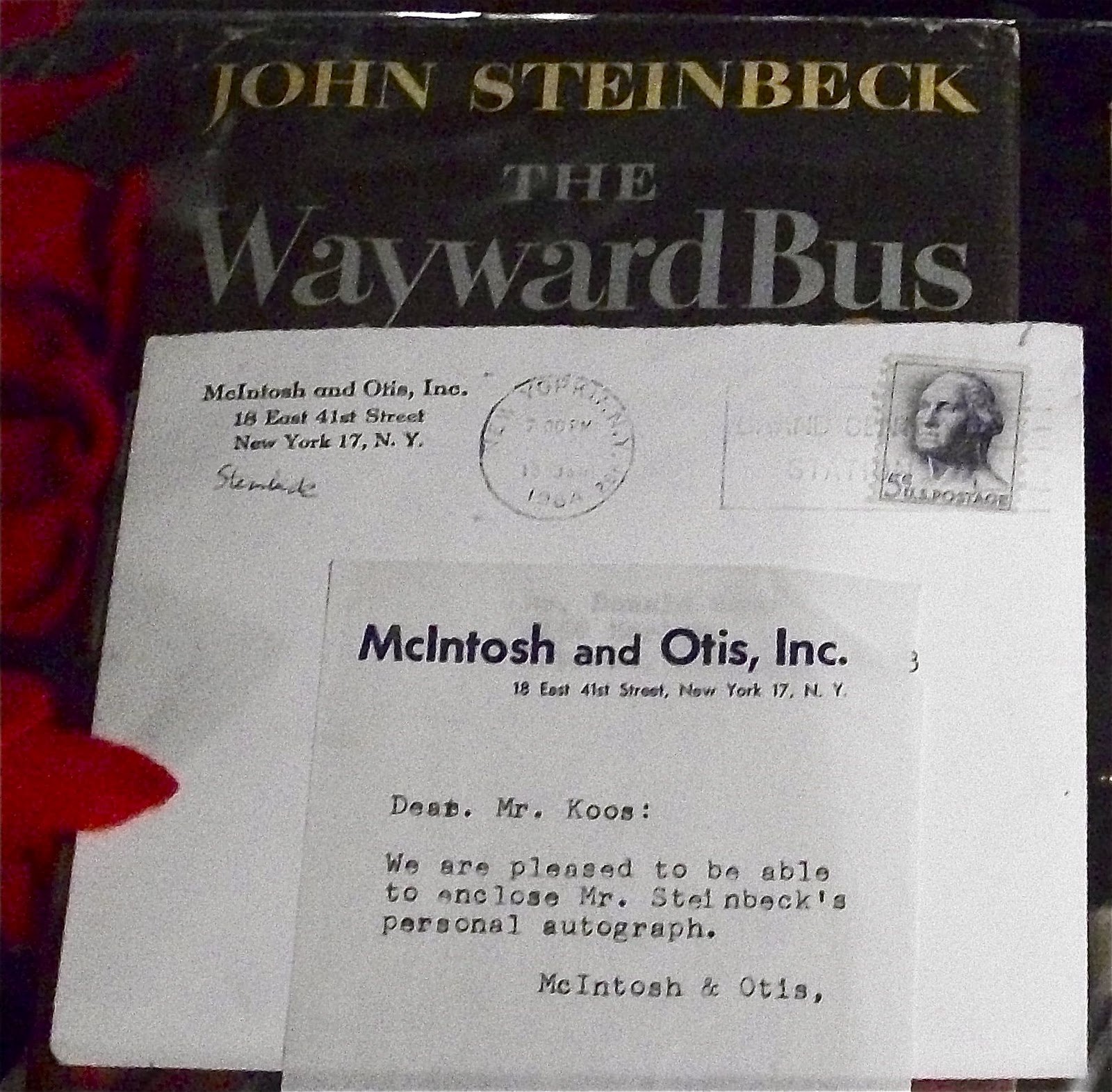
Signed 1st Edition Steinbeck w/Letter
1st Edition
Signed 1st Edition w/Scarce Dustjacket


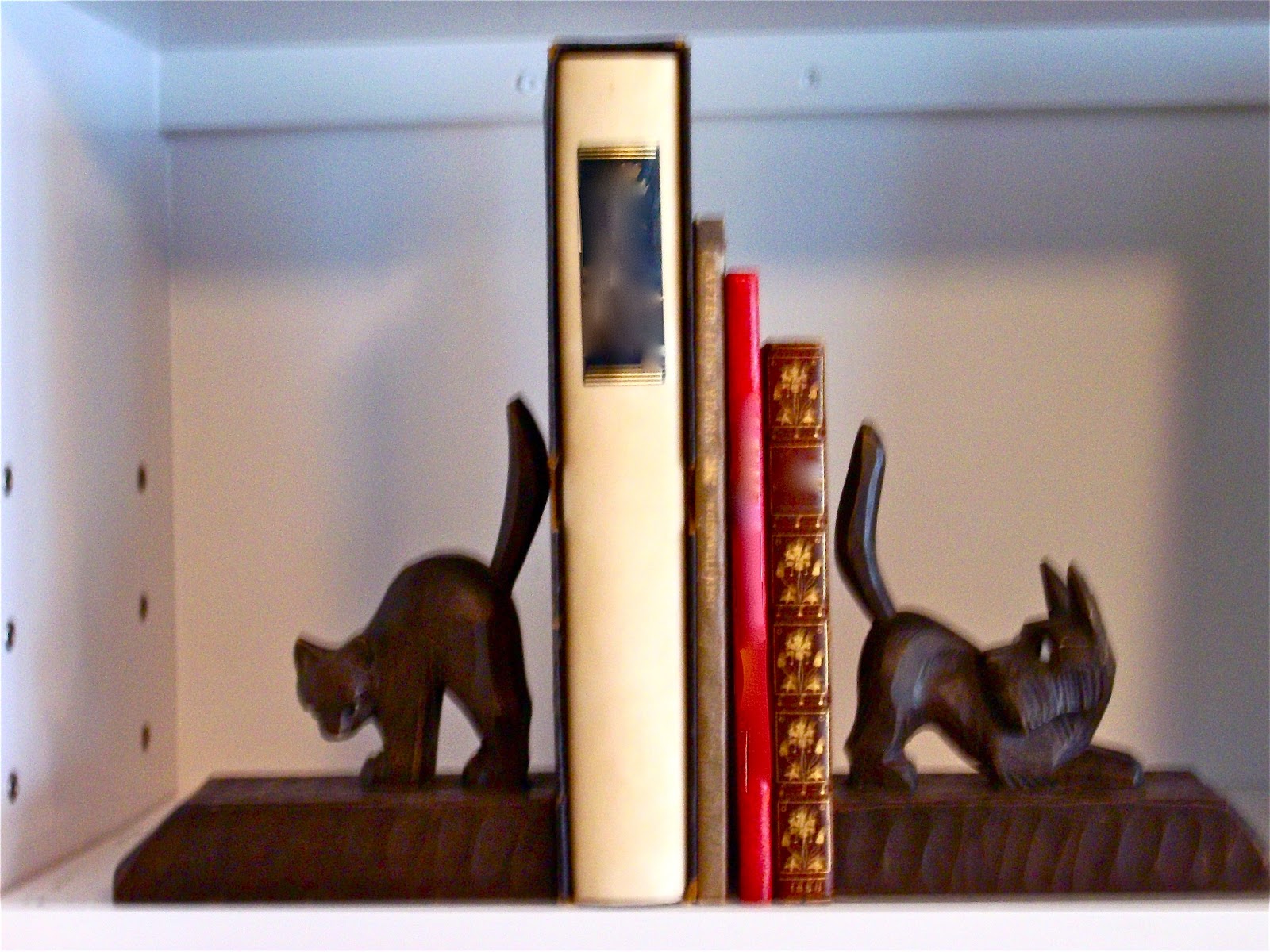
Bookends.
Bookend?

Pen & Pen Holder with it's own Inkwell
Original Drawing by Kate Greenaway


Scarce 1933 Pencil Sketch from the Disney Studios.
 And here's the very best:

Wonderful Inscription from George Bernard Shaw to Douglas Fairbanks Jr.
I have lots of bags and and boxes of books like the one in this photo to sort, catalog, and shelve before reopening day, but before I do that and before I end this post, I want to mention that Pamela Grath of Books in Northport, last week's guest blogger, told me that visits to her blog spiked dramatically after her guest post on this blog.  Of course, we have all of you to thank for that.

So:  Thank you!   And enjoy the new season.

Sunday, October 2, 2011

Guest Post: Bookshop Movies

This is a “guest” post by my friend and fellow bookstore owner, Pamela Grath.  Her store is in Michigan, but her blog, Books in Northport, is linked from my Books Blog under “Blogs I Follow.”
 
Back in 1996, Pamela came to our bibliofind.com site, and I had the pleasure of helping her join and learn the ropes.  She and I have never met, but obviously, we enjoy many of the same things – including our April Fools' Day birthdays! – and we have remained in contact over the years.

You will see when you go to her blog that Pamela is an enthusiast – about books, about animals, about nature, and about her part of the world – and her photographs are often so stunning that you want to get on a plane and go there immediately! For now, though, we’ll have to content ourselves with her blog.

But the best description of Pamela is the one she uses to describe herself on her blog:
Blogger, bookseller, philosopher, photographer, writer. Negligent but devoted gardener.  Good cook when inspired. No kind of housekeeper at all.
Here, without further ado, is Pamela’s post.  Enjoy!

Bookshop Movies
Harold groaned when she told him to read everything again. He thought he’d be bored out of his mind, going back and reading the same books he’d already finished. He was stunned to find that the second time through they were different books. He noticed entirely different points and arguments. Sentences he had highlighted seemed utterly pointless now, whereas sentences he had earlier ignored seemed crucial. The marginalia he had written to himself now seemed embarrassingly simpleminded. Either he or the books had changed. 
– David Brooks, The Social Animal: The Hidden Sources of Love, Character and Achievement
I maintain that the same is true of movies, that you can never watch the "same" movie twice, an assertion that shocked the Philosophy and Film instructor whose teaching assistant I was one semester. In our house, David and I are re-watchers as well as re-readers. The other evening we re-watched a wonderfully witty Hugh Grant and Julia Roberts movie, “Notting Hill.” The number of great almost-throwaway lines in the script had us hooting aloud. 


The bookstore [someone's big chance: the real bookstore is now for sale] doesn’t play a huge role in “Notting Hill,” but naturally it’s part of the attraction of the movie for a bookseller, and that got me to thinking about other films with bookstore settings. The one that leaps to mind first is the obvious, the popular “You’ve Got Mail.” With Tom Hanks and Meg Ryan, who can resist? And the movie has a happy ending, too, with the out-of-business bookstore owner turning children’s book author--probably not the fate of many bookstore proprietors who have gone out of business. Please note that “The Shop Around the Corner,” starring Jimmy Stewart, the film that inspired “You’ve Got Mail,” was set in a leather goods store, not a bookstore. Whole different kettle of fish, from a bookseller’s perspective. How's the market for leather goods these days?

The movie version of “84 Charing Cross,” definitely a bookshop story, was nowhere near as good as the book, but I’m sure it’s hard to make a movie out of years of mail correspondence, with no face-to-face encounters and no action, nothing but the requesting and receiving of books mailed across the Atlantic. Perhaps it ought not to have been attempted. 


The Amy Irving character in “Crossing Delancy” works in a bookstore, and, as the organizer of author events, she enjoys the touch of literary glamour on the fringes of her job. The focus of the movie, however, is her search for Mr. Right; as in “Notting Hill,” the bookstore in “Crossing Delancy” is not the main setting of the movie. On the other hand, it’s more than just a brief scene.... Scene? Seen? (Synapses fire, and the mind leaps.) Have you seen “The Answer Man” with Jeff Daniels? Now there’s a film that covers all the bases, from a writer’s life and secrets and his agent’s agonies through the vicissitudes of publishing to the struggles of retail bookselling. I found it riveting and hilarious. 


Poking around, I have come up with a couple of movies I never heard of before featuring bookstore themes. Anyone know anything about “The Bookstore” or “Heaven’s Bookstore”? Both are foreign films, the latter Japanese, neither listed on Netflix. I’ve added “The Love Letter” and “Read You Like a Book” to my queue. Will I be disappointed? 


Here’s what’s really on my mind: What I'm dying to see are film versions of Christopher Morley’s two classic novels about the bookselling life, Parnassus on Wheels and The Haunted Bookshop. “Could they be updated to a modern setting?” David asked. No, no, a thousand times no! They are period pieces! They are, as I said, classics, iconic works for American booksellers, especially those of us who sell used books and grew up on the Morley dreams. Roger Mifflin must drive the countryside from farm to farm in his horse-drawn gypsy-style wagon in the first story, and the second absolutely must be set in the World War I era. Anything else would be heresy. Please, someone make these movies--but for God’s sake don’t screw them up! 


The Philco-Goodyear Television Playhouse, which ran from 1948 to 1955, apparently presented "Parnassus on Wheels" in 1951. I wonder if it was any good. Why has no one since produced film versions of these stories of the eccentric bookseller from Brooklyn? As printed books become objects of nostalgia, surely the time is ripe, and America is ready, for a movie that would dwell lovingly on this important part of our cultural heritage? 


Postscript: If you don't know Christopher Morley, introduce him to yourself with this short essay on the thrill of visiting bookshops with an explorer's attitude of discovery, and you'll see why we booksellers with open shops continue to adore this writer as the world whirls by our doors.

Sunday, September 25, 2011

Food Writing

I’m not a great cook, but I nevertheless love to read books that include a fair amount of food-writing. By that, I don’t mean cook books – I can’t “taste” food by reading a recipe the way some of my “foodie” friends can. And I also don’t mean books like Gwyneth Paltrow’s, which are essentially recipe books with some background about why the author is interested in food, family and healthy life-choices….

The food books I love are novels, memoirs, travel books, etc., in which food helps drive the plot; or in which food is the vehicle which illuminates the characters, or is shown to “form” their personalities, or describes their relationships with others; or which illustrate how food and cooking can serve to comfort or empower.

This is a large and varied genre.

WOMEN WHO EAT is a collection of essays by women in which they describe their various relationships with food. Some are professional cooks, but most are writers who tell of their feelings and memories of food. It’s a celebration of food and of women who enjoy food without shame or apology.


There are lovely essays about bonding with grandparents while working in the kitchen together; there are reflections about the pleasure of making a meal, because it is one of the few activities in which there are no “loose ends,” as a meal “has a beginning, middle, and end.” Simple and clear.

Because I'd had similar experiences, I especially enjoyed the essay by Pooja Makhijan, whose mother would put exotic “aloo tikis” into her lunch box, so unlike the “American” food her classmates had in theirs – and theirs were the kind of lunches she'd always longed for!

With the same good intentions, my mother would often pack my brown paper bag with a [healthy] whole tomato to bite into like an apple (juice running down my chin and neck) and a sandwich on rich rye bread. And oh, how I, too, longed for a sandwich on real “American” white bread!

Most of the essays in this book were entertaining, though none felt entirely "new."  And I hope you'll excuse me if I say that they're a bit like appetizers before the main course....

In Ruth Reichl’s memoir, TENDER AT THE BONE, the former restaurant critic and editor of the now defunct GOURMET magazine remembers a childhood that prepared her for a future in the food world. Reichl describes in sometimes hilarious detail, her early and strange connection with food.


Her "manic-depressive" mother loved to entertain, and depending on her mood, or on the latest “bargain” of ready-for-the-garbage food, or whatever decaying carcass she found in her larder, she often served food that was spoiled or moldy. Before the age of 10, Reichl understood that “food could be dangerous” and saw it as her “mission…to keep Mom from killing anybody who came to dinner.” She sometimes stood in front of guests to prevent them from getting to the buffet; and bluntly told her own friends, “Don’t eat that,” as they unsuspectingly plunged their spoons into dishes like bananas in green sour cream.

Her role as “guardian to the guests” made her aware of food in a way that might not have occurred otherwise. She began “sorting people by their tastes” and finding that she could learn a lot about people from the foods they chose and the places in which they liked to eat. And she continued to observe and learn about food as she made her way from New York to a French boarding school in Montreal and a commune in Berkeley; as she came under the wings of people like Alice Waters and James Beard.

Liberally sprinkled with recipes, this adventure in food has a happy ending, as Reichl got to live her passion of cooking and eating and teaching people about food.

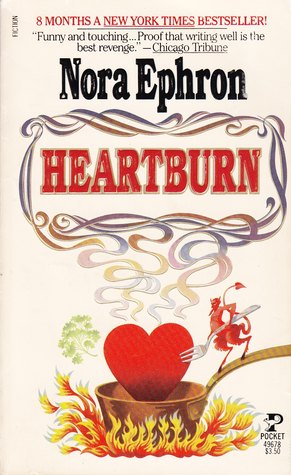
Nora Ephron’s HEARTBURN is a slyly fictionalized account of her divorce from journalist Carl Bernstein. The novel’s heroine, Rachel, is a food writer, and Ephron uses food and recipes as the conceit with which to describe Rachel’s relationship and marriage, from its beginning to its end.


Seven months pregnant at the time that she discovers that her husband is having an affair, Rachel reviews the trajectory of their marriage:

When first in love, [she] prepares labor-intensive and time-consuming “crisp potatoes;” when they settle into a married life busy with a child and home improvements, it’s the complacency and self-assuredness of “peanut butter and jelly on white bread.” (Yum!) With the knowledge of her husband’s affair, it’s “heartburn” and a punishing refusal to give him her wonderful vinaigrette recipe. Then it’s self-pity and the comfort of mashed potatoes…. Finally, she accepts that she can do without him, and expresses that acceptance by throwing a pie in his face – and by her willingness to give him that vinaigrette recipe after all: in essence, she is saying, “You can have it, and I’m out of here!”

Forget the Meryl Streep and Jack Nicholson film of the same name; this is a delicious, insightful, and wickedly funny book. And the great recipes are an added bonus.

More and more common in the food-writing genre are the books that tell of people moving to a “foreign” country and navigating their way through that new landscape. And food is a major player in these journeys.

In Marlena De Blasi’s A THOUSAND DAYS IN VENICE, American restauranteur and cookbook writer De Blasi tells of her love-at-first-sight romance with a Venetian man she sees across a crowded room – really! – and of her move to Venice to be with him. And for all its beauty, it’s an inhospitable Venice she comes to, steeped as it is in old traditions which have no room for newcomers.


But De Blasi haunts the local food markets at 5:00 AM each morning, and with her knowledge and love of food, she seduces the locals and becomes “one of them.” Then, she repeats this feat in her sequel, A THOUSAND DAYS IN TUSCANY, where she eats at the small local restaurant to which everyone in the neighborhood – including she – brings food for communal dining. Soon, she is one of them there, too.

Passionate about food, De Blasi describes the local produce and the markets and the centuries’ old food traditions with eloquence and ease. You read these books with mouth-watering pleasure – and a longing to become an “insider” in Italy, too!

Finally, there’s the food-writing in travel books that have no plots to speak of, but which describe food’s connection to the land, the landscape, the city, the town, the community. These books give you a sense of the rhythm of life there; and you are like a voyeur, looking through the windows of the folks who are living the dream.

Peter Mayle’s A YEAR IN PROVENCE and Frances Mayes’ UNDER THE TUSCAN SUN are two such books. In these, we watch the British Mayle and the American Mayes (with their very similar names!) as they renovate fabulous houses with seemingly unlimited funds. Here, too, we see them prepare the local foods of the season, and discover the bounty of the land.


These are books you can dip into, reading a passage here and there, now and then. And sometimes, you’re rewarded with an unforgettable description of the connection between food and nature and the life cycle, as in this excerpt from UNDER THE TUSCAN SUN:
“The fig flower is inside the fruit. To pull one open is to look into a complex, primitive, infinitely sophisticated life cycle…. Fig pollination takes place through an interaction with a particular kind of wasp about 1/8 of an inch long. The female bores into the developing flower inside the fig. Once in, she delves with her…needle nose, into the female flower’s ovary, depositing her own eggs. If she can’t reach the ovary, she still fertilizes the fig flower with the pollen she collected from her travels. Either way, one half of this symbiotic system is served – the wasp larvae develop if she has left her eggs, or the pollinated fig flower produces seed. If reincarnation is true, let me not come back as a fig wasp. If the female can’t find a suitable nest for her eggs, she usually dies of exhaustion inside the fig. If she can, the wasps hatch inside the fig and all the males are born without wings. Their sole, brief function is sex. They get up and fertilize the females, then help them tunnel out of the fruit. Then they die. Is this appetizing, to know that however luscious figs taste, each one is actually a little graveyard of wingless male wasps? Or maybe the sensuality of the fruit comes from some flavor they dissolve into after short, sweet lives.”
It’s fig season: enjoy them!

Wednesday, September 14, 2011

Auctions

Not so long ago, it was advantageous to attend an auction in order to do well at it.  Only then could you get the best price; could you watch the other bidders and decide whether you could compete with them or not; could you see an opportunity and jump in to grab a bargain.

Not so long ago, if you stayed at the auction to the very end – long after others in the room had spent their allotted funds or gotten what they wanted – you often found that there were so few left in the “competition” that you were able to win many prizes on a small budget.

Not so long ago, knowledge could mean the difference between success and failure.  Once, for example, as the only ones at an auction who could read German, we scored a fabulous book which no one else in the room could know was fabulous!

Not so long ago, happy chance could mean the difference between victory and defeat, between a bargain and paying top dollar.  At one auction, somehow, the other bidders didn’t make the connection that Henry George Wells was H.G. Wells, so I was able to walk off with a manuscript for half of what I’d expected to pay.

Not so long ago, attending an auction was like participating in an interactive-theatrical event, with the excitement and the anticipation and the unexpected all unfolding as part of a drama.

No longer.

At a big New York City auction yesterday, I felt that “not so long ago” was very long ago, indeed, and that everything I’d known about auctions was no longer true.

Now, everyone in the room knows everything:  if they hadn’t already “googled” it, they are busy on their “smart phones” getting the information then and there.

Now, you have huge numbers of invisible bidders from all over the world bidding against you, not just by phone, but also via the Internet! 

Now, you can’t see most of your competitors, so you don’t know whether they are knowledgeable bidders or just rich folk who are used to getting whatever they want at whatever the price; you don’t know whether they’re bidding from Paris or from around the corner; you don’t know whether they’re buying for resale or for themselves.

Now, there is no advantage – none! – to being in the auction room, as the internet bidders have become the preferred ones. 

Yesterday’s auction was held up several times – once for about 40 minutes! – in order to accommodate a slow or failing internet feed.  When the bidders in the room grumbled about this, we were admonished by the auctioneer that these were “serious” bidders and that the “house” just “couldn’t go on without them.” Someone shouted, “We’re serious bidders, too.”  But all that got for us were some pastries, as we continued to wait….

Over and over again, the internet bidders were given preference over the bidders in the room.  Whereas we in the room were pressured into making quick and sometimes hasty decisions –

“Fair Warning:  Going Once, Twice, Sold” –

the Internet bidders were told,

“Fair Warning:  Going Once ………….. Going Twice…………. Are you sure?…………….  Fair Warning:  Going Once………. Going Twice………” 

You get the picture.

The prices were incredibly, sometimes laughably high, and the “professionals” in the room kept shaking their heads in amazement.  (And aren’t we in a recession?  Aren’t we supposed to be getting these things for a song now?)

The internet bidders seemed to have limited knowledge and unlimited funds.  And the bidders in the room served the auction house well by bidding up items before dropping out and leaving the field to the internet ones; then we [with our pastries] got to listen silently as these invisible bidders bid against one another:   Fair Warning:  Going Once……….. Going Twice……….. Are you sure….?

Not surprisingly, the only items that sold for amounts below their estimates were the ones on which no one in the room bid against their internet competitors.  Loud complaints were expressed as the people in the room made their way out the door at the auction’s end.

I was hot and tired and disappointed, but I’d always chided myself for not attending these auctions, and now I’d learned an important lesson:  I don’t have to take a 3-hour trip into Manhattan; I don’t have to deal with the traffic and the noise and the heat of the city; I don’t have to worry about finding a cab or getting a good seat at the auction. 

Instead of being in the auction house and bidding up the prices for them, I can claim the internet bidder’s advantage and do it all from the comfort of my living room.  And I will. 

Fair Warning.